Jan. 9, 2026
Sore vs. Herpes: What’s the Difference, and When Should You See a Doctor?

Ana Weil, MD
Jump to
Book a visit
$25 typical copay
$100 without insurance
Experiencing cold sore or herpes symptoms? Talk to a doctor today.
A cold sore or herpes treatment consultation connects you with a licensed doctor who can evaluate your symptoms and help you feel better — fast.
Does a blister on your lip—or, eesh, somewhere else—have you worried? Understanding what a cold sore vs herpes actually looks and feels like is key to knowing what’s actually going on. Plus, it will help you figure out how to feel better (and protect others) faster.
That sudden tingle or blister on your lip can send your brain straight into panic mode. It often leads to one pressing question: What does a cold sore vs herpes feel like? I’ve been there.
I used to get painful cracks at the corners of my mouth and spiraled into worry that each might be a sign of herpes, complete with seemingly scary long-term implications. (Plot twist: My mouth sores turned out to be angular cheilitis, and they cleared up once I addressed a nutrient deficiency. Yet I still remember the confusion and stress of the not knowing.)
So let’s slow things down and get clear. The big question most people are really asking is: Are cold sores always herpes? And what’s the real difference between “cold sores” and “herpes sores,” anyway? Here’s where language makes things messier than it needs to be. Cold sores are caused by the herpes simplex virus, but when people say “herpes,” they’re often talking about genital herpes, which is a different presentation and comes with a whole lot of unnecessary stigma. (Truly, we need to move on already.)
In this guide, we’ll break it all down in plain English: what causes cold sores, what cold sores look like compared to genital herpes sores, how the virus spreads, what treatments actually help, and when it’s time to see a doctor. You’ll also learn how to lower your risk of spreading it—and how to get fast, virtual care and prescriptions when appropriate—so you can stop spiraling and start feeling better, sooner.
Cold sore vs herpes: clearing up the terminology
Let’s get this out of the way: cold sores are herpes, and herpes isn’t the scandalous monster the internet makes it out to be. Cold sores—aka fever blisters, aka oral herpes, aka herpes labialis—are painful, fluid-filled bumps that pop up around the lips. The fluid inside them is contagious and caused by the herpes simplex virus (HSV), but they’re not the end of the world, and there are effective treatments available.
There are two types of HSV:
HSV-1 is the usual culprit behind cold sores (oral herpes) and is incredibly common—more than half of Americans pick it up by their 20s, and some estimates put adult infection rates as high as 90%.
HSV-2 typically causes genital herpes, showing up as blisters on or around the genitals or rectum.
Here’s where things get twisty:
- Genital herpes is usually caused by HSV-2, but HSV-1 can cause it too.
- And you can get oral herpes from someone’s mouth or from performing oral sex on someone with genital HSV-2.
Bottom line: whether it's HSV-1 or HSV-2, cold sores always come from the herpes simplex virus, says David Johnson, MD, board-certified dermatologist and co-founder of RedliteX.And to make things even trickier, other conditions can produce look-alike sores (more on that soon).
A huge part of the confusion around cold sores comes from stigma and misinformation about “herpes.” But herpes—oral or genital—is incredibly common. In fact, CDC data shows over half a million new genital herpes infections occurred in the U.S. in 2018 alone among people 14 to 49.
Herpes is an ordinary medical condition, not a moral failing. “Many people suffer from herpes,” says Dr. Johnson. “This virus does not define your character.”
Now that we’ve cleared up the naming controversy, let’s look at what actually triggers the virus.
What causes cold sores and genital herpes?
If you’ve ever wondered what causes cold sores, the short answer is simple: the herpes simplex virus.
Cold sores—oral herpes—are usually caused by HSV-1. You may be surprised to learn that most people pick it up in childhood! Yes, from totally nonsexual things like sharing cups, utensils, or getting kissed by a well-meaning adult. You can also get oral herpes from performing oral sex on someone with genital HSV-2. Yikes.
Genital herpes is typically caused by HSV-2, but HSV-1 can cause genital infections too—usually through oral-genital contact. In other words, herpes doesn’t always follow the “type 1 = mouth, type 2 = genitals” rule.
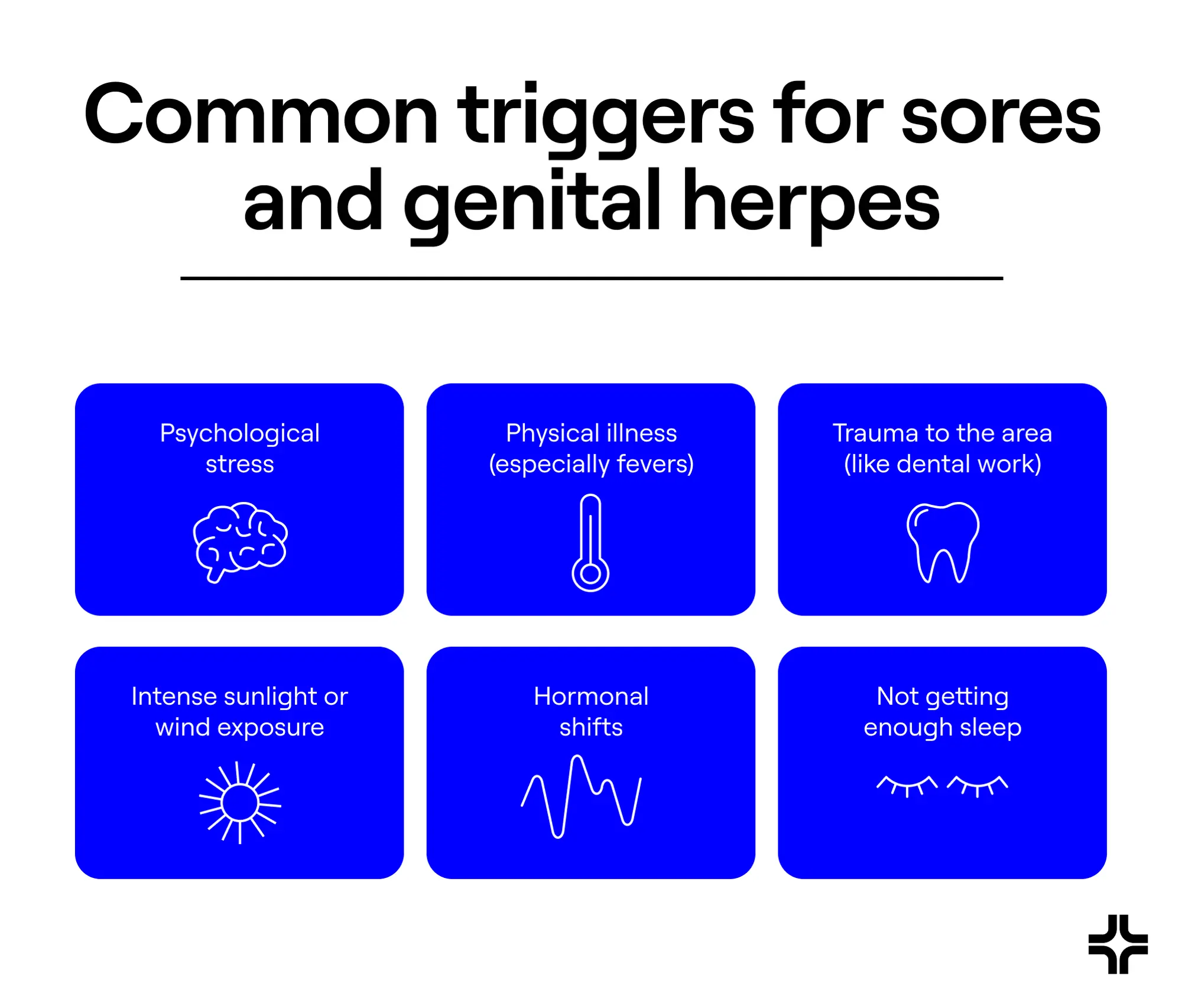
Common triggers for sores and genital herpes
No matter the route—oral or genital—the herpes virus acts the same once it infects you. After HSV enters your body, it sets up camp deep inside your nerve cells, specifically the dorsal root ganglia, says Dr. Johnson. And it usually stays there “sleeping” (aka latent) and causing any problems, where it typically stays for a person's entire life.
“During latency, the viral DNA remains sequestered inside the nerve cells, not actively replicating, making it invisible and inaccessible to both the body's immune system and antiviral medications,” says Brian Honeyman, MD, PhD, a board-certified physician in hospice/palliative care and internal medicine and clinical advisor at iRely Recovery. “Essentially, the virus ‘hides out’ in the cells until reactivation.”
So what shakes the virus awake again? The virus flares up, says Dr. Johnson, when the body is under stress, or other triggers. For example, that’s why athletes training intensely or students cramming for exams often see outbreaks, he says.
Dr. Honeyman adds that anything that stresses the immune system or irritates the skin around the area can flip the switch from “sleep” to “surprise flare-up.”
Common triggers include, per Drs. Johnson and Honeyman:
- Psychological stress
- Physical illness (especially fevers—hence “fever blister”)
- Trauma to the area (like dental work or friction)
- Intense sunlight or wind exposure
- Hormonal shifts (hello, menstruation)
- Not getting enough sleep
What do cold sores and herpes sores look like?
If you’re Googling what do cold sores look like, you’re probably trying to decode a certain suspicious appearance on or around your mouth. Classic cold sores (oral herpes) typically appear on the outside of the mouth, clustered around the lips. They start as small, fluid-filled blisters and follow a pretty predictable pattern as they heal.
So, what does a herpes sore look like, exactly? Fever blisters often show up like:
- Small red blisters filled with clear or yellowish fluid
- Several tiny blisters that merge into one larger sore
- Blisters that break open and ooze
- Yellow, crusty scabs as the sore heals
- Pink, newly healed skin once the scab falls off
Genital herpes causes similar fluid-filled blisters, but they show up on or around the genitals or rectum. Once the blisters break, they can turn into painful open sores. Symptoms may include itching, burning, or discomfort—especially during urination—and healing can take a week or more.
Here’s the catch: looks can be deceiving. Not every sore near the mouth—or down below—is herpes. “Every lesion close to the mouth isn’t necessarily herpes,” says Dr. Johnson. “I see people confuse many lesions close to the mouth for herpes” all the time, he adds.
Common lookalikes include:
- Canker sores (aphthous ulcers): small, shallow, noncontagious sores inside the mouth
- Angular cheilitis: cracks and irritation at the corners of the mouth
- Impetigo: a contagious bacterial infection that causes crusty sores
- Allergic reactions or skin irritation
In rare cases, oral herpes can resemble sores linked to Behçet’s disease or infections like hand, foot, and mouth disease, which usually come with additional symptoms and more widespread lesions, says Dr. Honeyman.
Genital sores can be tricky too. Mild cases of genital herpes can be mistaken for a pimple, razor bump, or ingrown hair—or go unnoticed entirely.
Because appearance alone isn’t always reliable, the safest move is to see a clinician who can make an accurate diagnosis—whether the sores are oral or genital. Guessing can lead to unnecessary stress (or missed treatment), and clarity is always better than spiraling.
Symptoms beyond the sores: how cold sores and herpes feel
The blisters tend to steal the spotlight, but herpes (oral or genital) often sends warning signals before anything shows up on your skin.
For cold sores, many people feel a tingling, itching, or burning sensation around the lips days before a blister appears. Some also notice flu-like symptoms, including a sore throat, fever, swollen glands in the face or neck, or pain when swallowing.
Genital herpes can feel similar. Especially during a first outbreak, you might experience fever, body aches, fatigue, or swollen lymph nodes before or alongside sores.
Here’s the confusing part: some people have very mild symptoms—or none at all. That doesn’t mean the virus isn’t active or contagious. You can still contract genital herpes from a partner who doesn’t have visible sores or doesn’t know they’re infected.
Moral of the story: herpes isn’t always loud or obvious. Whether symptoms are subtle, intense, or invisible, awareness—and honest conversations—matter just as much as spotting a blister. Note that you can get infected from a person who doesn't know they have herpes (genital or oral)—it doesn't mean your ex-partner deceived you!
How cold sores and herpes spread (and how to reduce risk)
Herpes spreads through close contact, often before you even realize it’s there.
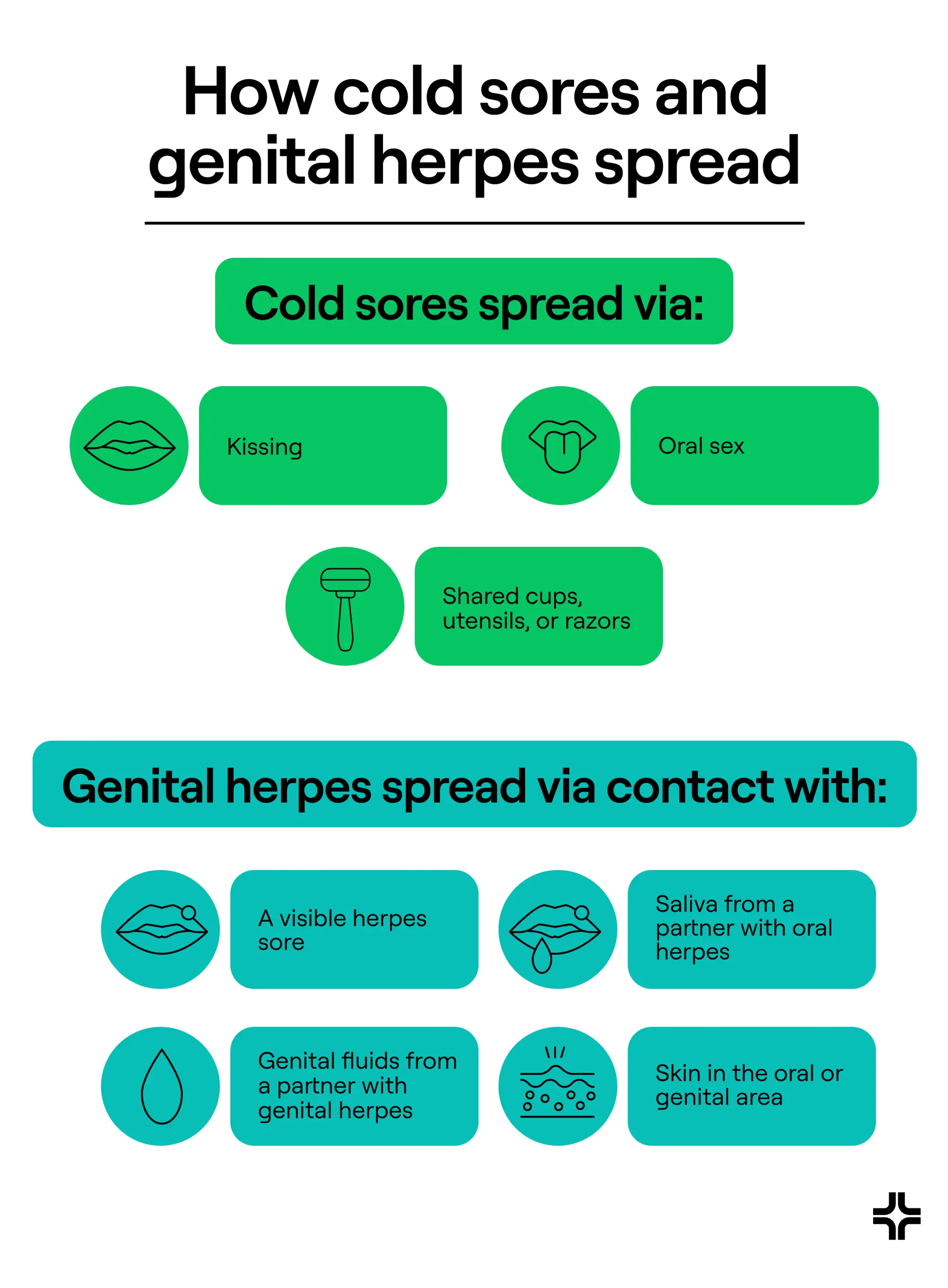
Cold sores (oral herpes) spread through intimate skin-to-skin contact like kissing or oral sex, but they can also pass through shared items such as cups, utensils, or razors if the virus is active.
Genital herpes spreads through sexual contact, i.e., vaginal, anal, or oral sex with someone who has the virus. Transmission can happen through contact with:
- A visible herpes sore
- Saliva from a partner with oral herpes
- Genital fluids from a partner with genital herpes
- Skin in the oral or genital area—even if it looks totally normal
Here’s the sneaky part: herpes can spread even when there are no symptoms. HSV can lie dormant (latent) in the body and still shed virus from the skin. That means someone can be contagious without having any sores or even knowing they’re infected.
While you can’t eliminate risk entirely, you can lower it significantly with a few smart steps.
For oral herpes:
- Skip kissing and oral contact during outbreaks or when tingling/burning starts
- Don’t share cups, utensils, lip balm, or razors during symptoms
For genital herpes:
- Avoid vaginal, anal, and oral sex during outbreaks (including fever blisters around the mouth) or early warning signs
- Use condoms consistently (they reduce risk but don’t cover every possible sore)
- Use dental dams during oral sex
- Daily antiviral medication that reduces the virus levels can significantly reduce transmission risk
The most underrated prevention tool? An honest conversation. Talking openly with partners about herpes status isn’t awkward—it’s empowering. Knowing the facts helps you both make informed, safer decisions about sex and intimacy.
Herpes is common, manageable, and not a moral failing—just a virus that can be treated more effectively when we understand how it spreads.
Diagnosis and treatment options: getting a clear answer
First things first: getting the right diagnosis matters. In many cases, a clinician can diagnose oral or genital herpes just by examining visible sores. To confirm, they may swab a blister and test it for HSV using methods like a viral culture or Tzanck test. Timing is key: testing early—before sores crust over—makes results more accurate.
No sores? There’s still a way to check. If you don’t have active lesions, a blood test can look for HSV antibodies, which can show whether you’ve been exposed to the virus in the past.
Can herpes be cured?
Not technically. Once HSV enters the body, it stays dormant in nerve cells (specifically the dorsal root ganglia) until something triggers a flare. In other words, herpes is lifelong. That sounds ominous, but for most people, outbreaks are occasional and treatable.
With the right plan, herpes is something you manage—not something that manages you. Here’s how to deal with HSV, so you can get back to living your life.
Treatment options for cold sores and herpes
Most herpes outbreaks clear up on their own within one to two weeks. That said, the right tools can shorten recovery and ease discomfort.
How cold sores and genital herpes spread
Short-term antivirals
Antiviral medications work by slowing the virus during an active outbreak. These include oral meds like valacyclovir and prescription topical creams. They work best when taken early, ideally at the first warning signs, before blisters appear.
“Current treatments can only suppress active replication during an outbreak,” says Dr. Honeyman. They cannot eradicate the dormant virus. That’s why flare-ups can return after healing, adds Dr. Johnson.
Daily antiviral suppression
For frequent or severe outbreaks, daily medication may be an option. Taking antivirals every day can reduce how often outbreaks happen and lower the risk of transmitting genital herpes to partners. This approach is often used by couples considering unprotected sex or planning pregnancy.
Over-the-counter relief
Sometimes simple comfort measures go a long way.
For cold sores:
- Apply ice (or a warm compress) to ease pain
- Gently wash blisters with soap and water to prevent spread
- Skip spicy, salty, acidic foods and hot drinks
- Gargle with cool or salt water; try ice pops
- Take acetaminophen or ibuprofen for pain
- Use OTC creams like docosanol to help shorten symptoms, says Dr. Johnson
For genital herpes:
- Soak in warm (skip the bubble bath) water for 15–20 minutes
- Keep the area clean, dry, and free from tight clothing
- Use OTC pain relievers like acetaminophen or ibuprofen
Lifestyle strategies
Certain habits—especially those that support a healthy immune system—may help reduce how often outbreaks happen or make them easier to manage when they do.
Per Dr. Honeyman, helpful strategies include:
- Stress-reduction techniques
- Consistent use of sunscreen or SPF lip balm
- Prioritizing sleep, nutrition, and hydration
Identifying your personal triggers—and avoiding them when possible—can also make a big difference, adds Dr. Honeyman.
Cold Sore vs. Genital Herpes
Feature
Cold Sores (Oral Herpes)
Genital Herpes
Where it shows up
On or around the lips and mouth
On or around the genitals or rectum
Common cause
Usually HSV-1
Usually HSV-2 (but HSV-1 can cause it too)
What it feels like
Tingling, itching, or burning before blisters appear—sometimes with flu-like symptoms
Tingling, itching, burning, or pain—sometimes with flu-like symptoms
What it looks like
Small fluid-filled blisters that break open, crust over, and heal
Blisters that open into painful sores and heal over 1–2 weeks
Other symptoms
Swollen glands, sore throat, mild fever (especially first outbreak)
Fever, body aches, swollen glands—more common during first outbreak
How it spreads
Kissing, oral sex, sharing utensils or drinks
Vaginal, anal, or oral sex; skin-to-skin contact
Testing
Swab of a fresh sore or blood test if no sore is present
Swab of a sore or blood test if symptoms aren’t visible
Treatment
Antiviral meds can shorten outbreaks and reduce pain, if started early
Antivirals help heal outbreaks faster and reduce transmission, if started early
Long-term management
Treat outbreaks as needed; daily meds rarely required
Daily antivirals may be used for frequent outbreaks or to lower spread risk
Big takeaway
Extremely common and manageable
Common, manageable, and nothing to be ashamed of
Working with a healthcare provider (virtual and in-person care)
Dr. Google is tempting, but this is one time it’s worth getting a real opinion. When an oral or genital sore pops up, it’s natural to want to self-diagnose, especially if embarrassment is in the mix. (Quick reminder: herpes is a very common medical condition, not a moral failing or a “dirty secret.”) Still, many rashes and sores can look like herpes, and appearance alone isn’t always reliable. Skip the guessing game—it can delay treatment that could actually help.
For a solid diagnosis, see a trusted primary care provider or sexual health clinician who can evaluate symptoms, order testing if needed, and help build a treatment plan. Virtual visits can also be a great starting point. Telehealth clinicians—like those at General Medicine—can review symptoms, look at photos when appropriate, and decide whether in-person testing makes sense.
And, yes, they’ll ask questions—that’s a good thing. Whether your visit is online or in person, your provider may ask about symptoms and sexual history. That information helps them give you the safest, most effective care. Their role isn’t to judge; it’s to support you.
Don’t let outdated stigma keep you from getting answers. A healthcare provider can help you manage outbreaks, reduce transmission risk, and navigate bigger questions (like what herpes means during pregnancy or in relationships). Open, honest conversations are one of the best tools you have for protecting your health and your partners’.
When to seek care (red flags you shouldn’t ignore)
Let’s be real: herpes flare-ups aren’t fun, but for most people they’re more uncomfortable than serious and clear up on their own within a week or two.
That said, some symptoms are warning signals from your body. HSV usually doesn’t cause major complications, but you should get medical care if an outbreak comes with any of the following:
- Fever
- Headache
- Vomiting
- Sores or blisters near your eyes (eye herpes can scar the cornea and, in rare cases, affect vision)
- Difficulty swallowing or eating
- A large amount of sores or spread to other areas of the face
- Symptoms that are severe or last longer than two weeks
- Extreme pain while urinating or defecating
- Not being able to urinate normally
Quality of life matters, too. Even if nothing on that list applies, it’s worth seeing a provider if outbreaks are becoming more frequent, more painful, or are interfering with daily life, sex, or your mental health. You don’t have to just push through—effective treatments exist.
Some situations need faster action. Get medical care right away if:
- You’re pregnant and have an active genital herpes infection (HSV can be passed during birth and cause serious illness in newborns)
- You have herpes and a weakened immune system due to HIV or certain medications (the virus can spread more easily and become dangerous)
At the end of the day, trust your gut. If something feels off—or worse than usual—it’s always okay to get checked out.
Living with recurrent cold sores or genital herpes
Despite what you’ve heard, many people live full, healthy lives with herpes. The virus is common, manageable, and though incurable, not a life sentence.
Your secret weapon? Know your patterns. Learning your early warning signs (like tingling or itching) and personal triggers lets you start treatment early, which can shorten or even stop an outbreak, says Dr. Honeyman. Supporting your immune system helps, too: manage stress, aim for at least seven hours of sleep, and fuel up with mostly nutrient-dense foods.
When outbreaks are frequent, modern medicine has your back. “Highly effective prescription antiviral medications are available to suppress recurrences and reduce transmission risk,” says Dr. Honeyman, “allowing for a near-normal, high quality of life.”
Talking openly with healthcare providers and partners, and using protection consistently, are key parts of managing herpes too. And if stigma is holding you back, remember this reassurance from Dr. Johnson: “This is a common health situation. You are not ‘dirty’ or ‘broken’—you’re human.”
The good news? The long game is encouraging. Herpes often gets easier to manage over time. “Most people have fewer outbreaks as they age,” says Dr. Johnson. With the right care and a little self-compassion, it tends to take up less space in your life.
The bottom line
When it comes to cold sore vs herpes, the confusion is mostly about language, not danger. Cold sores are caused by the herpes simplex virus (typically HSV-1), but “herpes” often refers specifically to genital infections (usually caused by HSV-2). Knowing what causes cold sores, what herpes sores look like, and when symptoms don’t quite fit the mold can help you make smarter choices about testing, treatment, and protecting partners.
And here’s the reassuring part: help is absolutely available. “Herpes is one of the most misunderstood skin problems that I deal with,” says Dr. Johnson. “Once people understand the facts, the fear diminishes. Once people understand how to manage it, the stress diminishes. And if they utilize the proper tools, such as good habits and proper care, they can control the situation and control their well-being.”
If you’re unsure what you’re dealing with—or just want a clear plan—talking to a healthcare provider is the best next step. With General Medicine, you can connect with an experienced clinician over video to discuss your symptoms and get personalized care from home, including prescriptions, lab orders, or referrals if needed. Clear answers. Less stress. A plan that actually fits your life.
Key takeaways
- Cold sores are herpes. Most cold sores are caused by HSV-1 (oral herpes), while “herpes” is often shorthand for genital herpes, usually HSV-2.
- Looks can be misleading. Not every mouth sore or genital bump is herpes, which is why testing—not guessing—matters.
- Triggers wake the virus up. Stress, illness, sun exposure, hormonal shifts, and poor sleep can all spark outbreaks.
- Herpes is common, manageable, and not a moral issue. Antiviral meds, lifestyle habits, and honest conversations go a long way.
- You don’t have to DIY this. A clinician can help confirm what’s going on and tailor treatment to your life.
General Medicine follows a strict editorial process, including using real experts to write our articles, vetted primary sources, fact-checking, a secondary medical review, and updates as necessary. This article was medically reviewed and fact checked by Ana Weil, MD.
FAQ
Do cold sores always mean you have herpes?
Yep—what people call a “cold sore” is usually caused by the herpes simplex virus (HSV-1). That said, not every sore near the mouth is herpes. Other skin conditions can look similar, which is why a clinician’s diagnosis matters.
Can I have a cold sore that isn’t herpes?
Some mouth sores look like cold sores but aren’t caused by HSV. Common lookalikes include canker sores, angular cheilitis (cracks at the corners of the mouth), impetigo, irritation, or allergic reactions. These aren’t herpes and aren’t spread the same way.
Is there a cold sore that’s not herpes?
Technically, no. By definition, a true cold sore (also called a fever blister) is caused by herpes simplex virus. If it’s not HSV, it’s not actually a cold sore, even if it looks like one. That’s why getting checked is helpful when you’re unsure.
How do you treat cold sores in children?
Cold sores are annoying enough for adults, but for kids? They can feel downright miserable and tough to manage when little ones don’t fully understand what’s going on.
Fortunately, you can ease discomfort and speed healing along the way. To help your child feel better:
- Use a cold compress (a clean, cold, damp cloth) on the sore
- Offer cool foods and drinks to make eating less painful
- Give pain relievers like acetaminophen or ibuprofen, if needed(Avoid aspirin—giving it to kids with viral infections is linked to a rare but serious condition called Reye syndrome.)
Important safety tip: Remind your child not to touch the sore and to avoid rubbing their eyes. If HSV-1 spreads to the eyes, it can cause serious infection and needs medical care right away.
Can you get a cold sore on your chin?
Sure can. Fever blisters typically pop up on the lips or around the mouth, but they can also form near the nose and on the chin.
Our editorial standards
At General Medicine, we cut through the clutter to make health care clearer, faster, and easier to navigate. Every article is grounded in evidence-based research and peer-reviewed journals, reviewed by medical professionals, and written in accessible language that helps you make health decisions with confidence. We’re committed to ensuring the quality and trustworthiness of our content and editorial process by providing information that is up-to-date, accurate, and actually useful. For more details on our editorial process, see here.