Jan. 6, 2026
How to Stop Sneezing Fast: 4 Methods That Really Work

Lane Thaut, DO
Jump to
Book a visit
$$25 typical copay
$100 without insurance
Coughing up colored mucus? Talk to a doctor today.
A virtual sinusitis treatment consultation connects you with a licensed doctor who can evaluate your symptoms, review your mucus changes, and help you feel better — fast.
That nonstop sneeze attack driving you wild? We’re breaking down exactly what’s behind it—and how to stop sneezing fast with smart, simple fixes that actually work.
If your browser history now includes “how to stop sneezing fast,” you’re probably trapped in that endless loop of sneeze–wipe–repeat. I’ve been there, I recently spent three days unleashing rapid-fire triple sneezes. Not cute. Not productive. And definitely not compatible with pretending to be a functional adult. (Mine turned out to be a run-of-the-mill cold, but still, chaos.)
Here’s the thing: While sneezing can be wildly annoying, it’s basically your body’s built-in bouncer, kicking out whatever unwelcome guest (virus, allergen, irritant, pick your poison) barged in. “Persistent sneezing usually happens because the nose is irritated and trying to clear out something that’s bothering it,” says Adam Carewe, MD. Translation: Your nose is doing its job, you just want it to do it quieter. So if you’re wondering why am I sneezing so much or how to stop sneezing and runny nose instantly without duct-taping your face, you’re in the right place.
In this guide, we’ll break down what actually causes those sneeze storms, how to get quick relief, the best OTC helpers, smart ways to cut down on triggers at home or work, and when it’s worth tapping in virtual care. Let’s get your nose to chill, stat.
Fast relief: what to do right now (safe, quick steps)
When a sneezing fit hits, you need tactics. Here are quick, safe moves that actually work.
Step away from the trigger
First things first: get away from whatever’s setting off your nose. Dust, perfume, cold air, sunlight—if you spot the culprit, remove yourself. “Immediately leave the environment or move away from the irritant,” says Shernell Surratt-Gary, DO, clinical advisor at Aura Recovery Center.
Flush out the irritant with saline
If your nose feels like it’s fighting for its life, a saline rinse is your reset button. “One of the fastest ways to calm sneezing is to rinse the nose with a saline spray or sinus-rinse kit because it washes out allergens, viruses, and irritants almost immediately,” says Dr. Carewe. It works fast because it “clears the nose mechanically “—no waiting around for meds to kick in, he adds.
Interrupt the sneeze reflex
How to stop a sneeze in its tracks? Hijack the signal. “Firmly press your index finger against your upper lip just under the nose,” says Dr. Surratt-Gary. This interrupts a branch of the trigeminal nerve, i.e., the one responsible for firing off the sneeze reflex. You can also take a deep breath and slowly, forcefully exhale through your nose to disrupt the impulse, she adds.
But don’t ever stifle a sneeze
Stopping a sneeze is fine. Trapping one inside your skull? Hard no. When you slam the airway shut, the pressure skyrockets—up to 20 times higher. That can lead to potential problems like:
- Eardrum damage or increased risk of ear infections
- Mucus and irritants blasted back into your sinuses (hello, sinus pain and congestion)
- A temporary spike in eye pressure, which can be risky for people with glaucoma
- Rare but serious ruptured blood vessels in the head or neck
Moral of the story: interrupt a sneeze if you must, but never cage it. Your sinuses will thank you.
Why am I sneezing so much? (common causes)
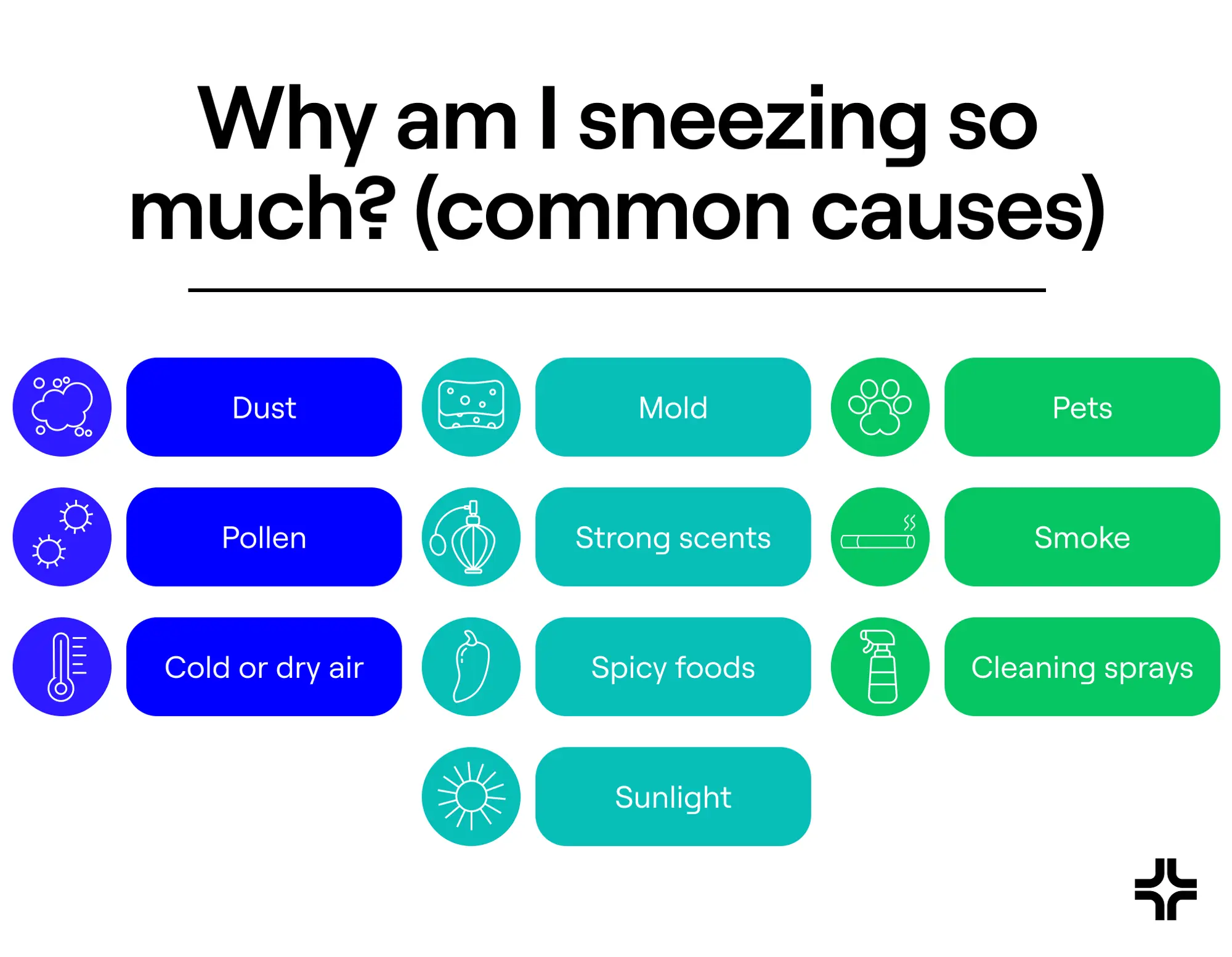
Common causes of sneezing
If your nose has suddenly decided to go full drama queen, there’s usually a reason for the excessive sneezing. Here are the most common culprits behind nonstop “achoo” attacks.
Allergies
If you’re sneezing like you’ve offended the pollen gods, allergies might be to blame for the inflammation in your nose.
Allergic rhinitis—aka hay fever—happens when you breathe in an allergen and your immune system overreacts. Cue the sneezing, itchy nose, watery eyes, postnasal drip, and that classic clear runny nose.
Common triggers include pollen, mold, animal dander, and dust mites, says Dr. Carewe. And yes—it's wildly common. About one in six people deal with allergic rhinitis.
Viral colds
Viral rhinitis (the regular old cold) is one of the most common upper respiratory infections around, and repeated sneezing is a pretty standard symptom during the first few days of a cold, says Dr. Carewe.
A sore throat shows up first for about half of people—sometimes within 10 hours of infection—followed by congestion, runny nose, hoarseness, and a cough that likes to overstay its welcome.
Nonallergic rhinitis
If you’re sneezing a lot, but allergy meds do nothing, you may have nonallergic rhinitis. “Some people have a sensitive nasal lining that reacts even without allergies,” explains Dr. Carewe.
Common non-allergic or irritant triggers include:
- Strong odors (perfume, scented candles)
- Cigarette smoke
- Cold or dry air
- Stress
- Weather shifts
- Spicy foods
Other irritants—like cleaning sprays or air pollution—can also spark sudden sneezing, says Dr. Carewe. Keeping a symptom diary can help you pinpoint the pattern.
Other forms of rhinitis
As we know, not all nasal inflammation is allergy-related, but some types are sneakier than you'd expect.
- Rhinitis medicamentosa (rebound congestion): Caused by overusing topical nasal decongestant sprays. It falls under drug-induced rhinitis and leads to persistent congestion once the medication wears off.
- Pregnancy rhinitis: Affecting about 20% of pregnant people in their second or third trimester, this condition causes congestion, sneezing, runny nose, and postnasal drip thanks to hormone-driven nasal swelling.
Photic sneeze reflex (ACHOO syndrome)
Ever step into bright sunlight and immediately sneeze three times? You might have photic sneezing, officially known as autosomal dominant compelling helio-ophthalmic outburst syndrome (achoo syndrome for short—yes, really). It’s a reflex where sudden exposure to bright light triggers uncontrollable sneezing.
The exact cause isn’t fully understood, but it may involve an overly excitable visual cortex sending mixed signals to the nerves that control sneezing. And because it’s related to genetics, you have a 50% chance of inheriting the “sunlight makes me sneeze” gene if your parent has it.
OTC options: how to stop sneezing and runny nose
When your nose goes rogue, a few smart OTC moves can usually help you get it back in line.Treatment depends on what’s causing your symptoms and how intense they are, but for most mild cases, you can tackle sneezing and drip at home.
Oral antihistamines
“For allergy-related sneezing, fast-acting antihistamines like cetirizine or loratadine usually help within about 20–60 minutes,” says Dr. Carewe. They work by blocking histamine—the chemical behind all that itching, dripping, and sneezing, adds Dr. Surratt-Gary.
Saline irrigation
If you want a low-tech, high-reward habit, meet the humble saline rinse.“Nasal irrigation is one of the most helpful daily routines for people with allergies or frequent colds,” says Dr. Carewe. It flushes out allergens, irritants, and viruses before they stir up trouble, and it may even help prevent sinus infections, he adds.
Intranasal steroid sprays
For long-lasting relief, steroid sprays are basically the gold standard, says Dr. Carewe. Over-the-counter options like generic Flonase or Nasacort calm inflammation inside the nose. “Starting nasal steroid sprays one to two weeks before your allergy season begins can significantly reduce symptoms—or even prevent them altogether,” he notes.
Pro tip: “Using a saline rinse before applying a nasal steroid helps the medication reach the nasal lining more effectively,” adds Dr. Carewe. Rinse first, spray second—this duo is one of the most powerful routines for controlling allergies.
Decongestants
Sneezing and stuffed up? Oral decongestants like pseudoephedrine (Sudafed) can give you short-term relief by shrinking swollen nasal passages. Some allergy meds even bundle an antihistamine with a decongestant for a one-two punch. Just check with your provider first—these meds aren’t right for everyone (more on that in a sec).
Avoiding triggers
Sometimes the best fix is simply dodging the stuff that sets you off. Irritants like dust, smoke, cold air, and strong scents can all fire up your sneeze reflex, says Dr. Carewe. Steering clear of your known triggers can help keep symptoms in check.
Home & habit fixes (prevention and control)
If you’re sneezing like it’s your new part-time job, your home might be the not-so-secret headquarters of your triggers. A little prevention goes a long way, especially when your sneezing stems from allergies or irritants. And because indoor air can be 2–5 times (sometimes even 100 times) more polluted than outdoor air, cleaning up your home environment is one of the most effective ways to calm an overreactive nose.
“Good home habits—like using HEPA filters, washing bedding weekly, and reducing dust and pet dander, can make a noticeable difference in sneezing,” says Dr. Carewe. Here’s how to give your living space a sneeze-friendly makeover:
Improve your indoor air quality:
- Avoid burning fires, candles, and incense indoors, they release pollutants.
- Skip air fresheners and heavily scented products loaded with harmful chemicals.
- Don’t smoke or vape indoors.
- Keep pets off furniture or beds, especially if allergies are involved.
- Use dust-mite–proof mattress and pillow encasements if you’re sensitive.
- Vacuum weekly with a HEPA vacuum to pull allergens out of carpets and rugs.
- If using products with chemicals or VOCs, improve ventilation and follow label instructions.
- Run exhaust fans in the bathroom (during showers) and in the kitchen (while cooking).
But indoor air is only half the story—your outdoor habits matter too. Even if your home is an allergen fortress, stepping outside can undo all your hard work. A few simple tweaks can dramatically reduce exposure when pollen counts skyrocket and help stop your sneezing before it becomes a problem.
Reduce outdoor allergen exposure:
- Stay indoors on dry, windy days (prime pollen time).
- Head outside after rain, when pollen gets knocked out of the air.
- Avoid lawn mowing, weed pulling, or gardening chores that kick allergens up.
- Change clothes and shower after being outdoors to rinse away pollen.
- Don’t hang laundry outside—pollen loves to cling.
- Wear a face mask if you must do outdoor chores.
- Keep windows and doors closed, especially overnight or during high pollen days.
- Skip early-morning outdoor activity when pollen levels peak.
Diagnosis and treatment options
If you’re sneezing is on hyperdrive, your doctor’s goal is to figure out why—and fast. They’ll start with a physical exam (yes, they’ll peek up your nose) and a rundown of your medical history. From there, expect a few detective-style questions to help pinpoint the trigger, like:
- How often are you sneezing?
- Does it hit during certain seasons, places, or situations?
- Do specific foods or activities set it off?
- Are you dealing with any other symptoms?
If allergies seem like the culprit, your provider may order blood tests or skin-prick testing to zero in on what’s setting off your immune system. They’ll also work to rule out other possible causes—like sinusitis, asthma, or even reflux—to make sure nothing else is behind your sneeze spree.
Once the cause is clear, you’ll get a tailored treatment plan to finally calm your nose down.
Non-surgical treatment options
Most sneeze situations can be tamed with simple at-home fixes. The right treatment depends on what’s triggering your symptoms, but these OTC go-tos cover most bases:
Oral antihistamines: Fast-acting options like cetirizine or loratadine can dial down allergy-driven sneezing within about 20–60 minutes. They work by blocking histamine—the chemical behind all that itch, drip, and achoo chaos.
Saline irrigation: A quick saline spray or rinse helps flush out allergens, irritants, and viruses. It’s one of the easiest daily habits for reducing symptoms and preventing sinus issues.
Intranasal steroid sprays: OTC steroid sprays (think generic Flonase or Nasacort) decrease inflammation inside the nose and offer long-lasting relief. Starting them one to two weeks before your allergy season ramps up can significantly reduce—or even prevent—symptoms.
Avoiding triggers: Dust, smoke, cold air, strong smells—basically anything that annoys your nose—can set off the sneeze reflex. Identifying and avoiding triggers can go a long way toward keeping symptoms in check.
Surgical treatment options
Sneezing itself seldom earns you a ticket to surgery, but sometimes what’s causing it does. “Surgery is rarely needed to address sneezing directly, but it may be necessary to correct any anatomical issues that make the nasal passages more vulnerable to irritants and chronic inflammation,” says Dr. Surratt-Gary.
Here are the most common structural issues that may require surgical treatment, according to Dr. Surratt-Gary:
- Deviated septum: When the wall between your nasal passages is off-center, it can cause chronic obstruction and irritation. Septoplasty can straighten things out and improve airflow.
- Nasal polyps: These soft, painless growths can block airflow or worsen inflammation. If they’re large or persistent, surgical removal may be needed.
- Turbinate problems: Turbinates are structures in your nose that help humidify incoming air, but chronically swollen ones can create severe congestion and irritation. Surgical reduction may help restore normal breathing.
Surgery is considered only after months of standard treatments—like nasal steroids, antihistamines, and saline rinses—haven’t brought enough relief, says Dr. Carewe.
Working with a healthcare provider
If you want real answers, show up prepared—your nose has a story to tell, and your provider needs the full plot.
Start by tracking your symptoms: when you sneeze, how often, what seems to trigger it, and which meds you’ve already tried. Bringing this info to your appointment—whether with your go-to doctor or at a virtual appointment like those offered at General Medicine—gives the clinician a head start. It helps them spot patterns, rule out red herrings, and zero in on what’s actually driving your symptoms.
During the visit, expect questions about your medical history, when the sneezing began, whether you have other symptoms, and if you’ve ever been diagnosed with allergies. Every detail offers a clue.
From there, your provider will do a physical exam—especially a close look inside your nose—and may recommend allergy testing for a clearer picture.
Once everything’s on the table, they’ll walk you through treatment options and lifestyle strategies. Together, you’ll build a plan that actually fits your life, and you’ll schedule follow-ups to make sure your symptoms are improving.
When to seek care (red flags)
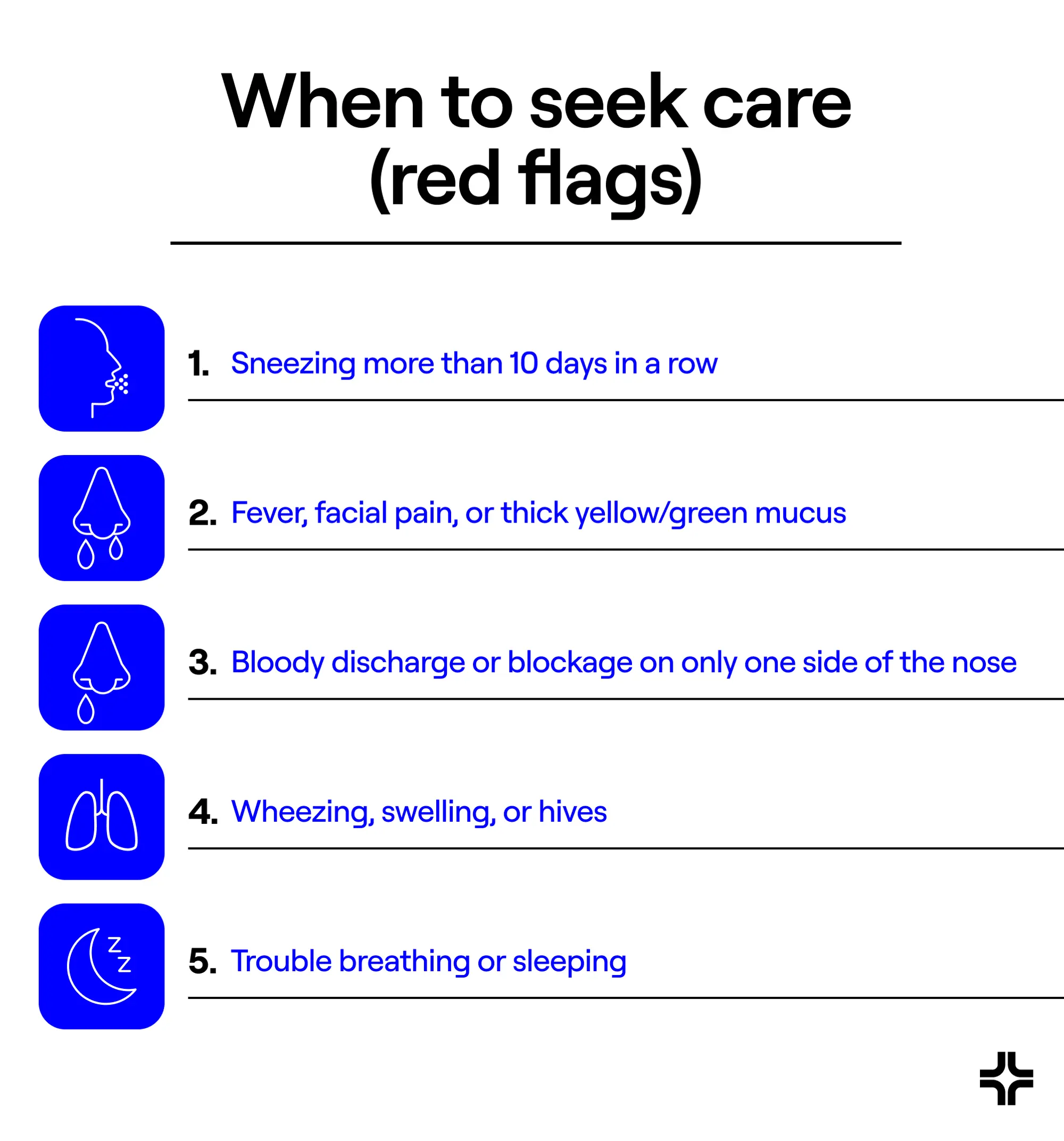
Sneezing red flags
Most sneezing is annoying—not alarming—but sometimes your nose throws up a flare you shouldn’t ignore.
Check in with your provider if you notice any of the following, say Drs. Carewe and Surratt-Gary:
- Sneezing that lasts longer than 10 days
- Sneezing so intense or frequent it disrupts daily life
- Fever, facial pain, or thick yellow/green mucus (possible sinus infection)
- Bloody discharge or blockage on only one side of the nose
- Wheezing, swelling, or hives (possible allergic emergency)
- Trouble breathing or sleeping because of sneezing or congestion
These symptoms can signal something more serious, and getting evaluated early can save you a lot of misery down the line.
Special situations
Sneezing isn’t one-size-fits-all—your treatment plan should match your stage of life and health needs. Certain conditions call for extra caution with meds or specific tweaks to your usual routine. Here’s how the approach shifts depending on pregnancy, underlying health issues, and age.
Pregnancy
When you’re expecting, gentle is the name of the game. During pregnancy, Dr. Carewe recommends starting with the safest basics: saline irrigation and humidifiers. Many antihistamines can be safe, but always clear them with your prenatal provider first. Oral decongestants, however, are usually off the table unless your clinician gives a very specific green light, he adds.
Glaucoma
Some allergy meds and glaucoma just don’t mix. “Older, sedating antihistamines can worsen glaucoma” and should generally be avoided, says Dr. Carewe. Safer bets? Newer nonsedating antihistamines and simple saline irrigation, he says.
BPH (enlarged prostate)
If you have benign prostatic hyperplasia (BPH), aka enlarged prostate, be selective with your sneeze meds. Sedating antihistamines can worsen urinary retention and make BPH symptoms more bothersome, says Dr. Carewe. Since BPH can already make urination tricky, and even lead to bladder or kidney issues, steering clear of these older antihistamines is key. Newer nonsedating antihistamines or saline rinses are safer options.
Heart disease or high blood pressure
Got heart issues? Think twice before reaching for a decongestant. If sneezing comes with congestion, you might be tempted to grab an oral decongestant. But for people with heart disease or high blood pressure, meds like pseudoephedrine and phenylephrine can raise blood pressure and heart rate, says Dr. Carewe. In short: avoid them unless your clinician says otherwise.
Children
For kids, simple solutions are usually best. Start with saline rinses, humidifiers, and allergen avoidance, says Dr. Carewe. If allergy medicine is needed, make sure it’s age-appropriate and follow dosing guidelines carefully, he adds.
Older adults
In older adults, some meds can cause more problems than they solve. “Sedating antihistamines can cause confusion and increase fall risk,” so nonsedating antihistamines and nasal steroid sprays are typically the safer choice, says Dr. Carewe.
The bottom line
Most sneezing is caused by allergies or everyday irritants, and luckily, it often improves fast once you ditch the trigger, rinse with saline, and use the right OTC tools consistently. Keeping tabs on your patterns (what sets you off and when) helps you stay ahead of symptoms and gives your provider the clues they need to zero in on the root cause. And of course, stay alert for red flags like fever, facial pain, bloody discharge, or symptoms that drag on for more than 10 days.
Ready to finally get your nose under control? Connect with a General Medicine clinician over video for personalized guidance, right from home. You’ll get a clear diagnosis, a targeted treatment plan, and any necessary prescriptions, labs, or referrals so you can breathe easier, sneeze less, and get back to your day.
Key takeaways
- Most sneezing comes from the big four: allergies, irritants, viral colds, or nonallergic rhinitis—plus curveballs like bright light–triggered photic sneezing.
- Quick relief starts with getting away from the trigger, doing a fast saline rinse, and using OTC helpers like antihistamines or nasal steroid sprays.
- Home habits matter: cleaner air, fewer irritants, and smart indoor/outdoor strategies can dramatically cut down sneeze attacks.
- Certain health conditions (pregnancy, glaucoma, BPH, heart disease, older age) change which meds are safest, so tailor treatment to your situation.
- Track your symptoms, triggers, and timing—this info helps your provider pinpoint the cause and rule out red flags like infection or structural nasal issues.
General Medicine follows a strict editorial process, including using real experts to write our articles, vetted primary sources, fact-checking, a secondary medical review, and updates as necessary. This article was medically reviewed and fact checked by Lane Thaut, DO.
FAQ
What is the fastest way to stop sneezing?
When a sneeze is loading, here’s how to shut it down—fast:
- Step away from the trigger: Move out of the dusty room, skip the strong perfume cloud, or get out of the cold blast of air. “Immediately leave the environment or move away from the irritant,” says Dr. Surratt-Gary.
- Flush out the culprit with saline: A quick rinse can work like a reset button. Saline sprays or sinus-rinse kits wash out allergens, viruses, and irritants almost immediately, says Dr. Carewe.
- Interrupt the sneeze reflex: Press your index finger firmly on the spot between your nose and upper lip. This temporarily disrupts a branch of the trigeminal nerve—the one that fires the sneeze reflex.
How do you treat allergic rhinitis in toddlers?
For tiny humans, start with saline rinses, a humidifier, and keeping allergens out of their environment, says Dr. Carewe. If medication is needed, choose an age-appropriate option and follow dosing instructions exactly.
How do you stop getting the urge to sneeze?
Catch the sneeze before it catches you. When you feel that first itchy tickle, press the spot directly between your nose and upper lip. Holding firm for a moment can short-circuit the reflex by blocking a branch of the trigeminal nerve and rerouting the signal that triggers a sneeze.
Where should you press to stop sneezing?
Find the center point between your nose and upper lip and press with your index finger. A brief, firm press can interrupt the trigeminal nerve signals and stop a sneeze in its tracks.
What causes too much sneezing?
Most sneeze attacks boil down to a few usual suspects:
- Allergies
- Irritants
- Viral colds
- Nonallergic rhinitis
- Photic sneeze reflex (aka the sunlight-triggered “achoo” burst)
To help your provider figure out what’s driving your symptoms, track your sneezing patterns—what sets it off, when it happens, and any other symptoms that tag along.
Our editorial standards
At General Medicine, we cut through the clutter to make health care clearer, faster, and easier to navigate. Every article is grounded in evidence-based research and peer-reviewed journals, reviewed by medical professionals, and written in accessible language that helps you make health decisions with confidence. We’re committed to ensuring the quality and trustworthiness of our content and editorial process by providing information that is up-to-date, accurate, and actually useful. For more details on our editorial process, see here.