Jan. 12, 2026
Can a Belly Button Infection Kill You? Causes, Risks, and How to Treat It Safely

Brian R. Wood, MD

Jump to
Book a visit
$$25 typical copay
$100 without insurance
Worried you may have a skin infection or another issue affecting your belly button? Book an evaluation today to get the expert help you need.
Noticing redness, odor, or discharge from your belly button can be unsettling. But can a belly button infection actually kill you? Very rarely. Most belly button infections are mild, stay on the skin’s surface, and improve with simple care when caught early. The key is knowing what’s normal, how to treat an early-stage belly button infection safely at home, and when to get medical help if symptoms start to escalate.
Your belly button doesn’t ask for much attention … until one day it’s red, itchy, smelly, or leaking something that definitely wasn’t there yesterday. Cue the spiral. A quick search later, you’re staring at the question no one wants to Google: Can a belly button infection kill you?
Fortunately, the vast majority of belly button infections are mild, surface-level issues caused by moisture, friction, or germs that like dark, cozy places. When caught early, they’re usually easy to manage and clear up without drama. Serious complications are rare, but they can happen if an infection is ignored or if someone has higher-risk health conditions.
Below, learn how to figure out what you’re dealing with, how to safely take care of a belly button infection at home, and how to spot the signs that mean it’s time to loop in a clinician.
Can a belly button infection kill you? Understanding the risk
The good news is that almost all belly button infections are minor and not life-threatening. The skin in and around the navel can become irritated or infected, but in most cases the issue stays close to the surface and improves with simple, early care.
An early stage belly button infection usually shows up as mild inflammation caused by bacteria or yeast. When the area is gently cleaned, kept dry, and treated promptly, it often clears before it has a chance to spread. That’s why timing matters so much: Early attention lowers the risk of complications.
A belly button infection only becomes concerning if it’s severe, left untreated, or occurs in someone with higher health risks (such as a weakened immune system). In those cases, it can spread beyond the skin, says Lavanya Krishnan, MD, a board-certified dermatologist at Arya Derm. It’s this spread—not the belly button itself—that increases the risk of serious illness.
What is a belly button infection?
There are a few common types of belly button infections, and while they can look similar at first, the symptoms often drop some helpful hints about what’s going on. Knowing which “category” your symptoms fall into helps guide what to do next—and just as importantly, how quickly to act—so a small issue doesn’t overstay its welcome.
Here’s the breakdown of the most common types of belly button infections, according to Krishnan:
- Bacterial infections: These tend to show up when moisture, friction, or tiny skin breaks give bacteria an opening. You might notice redness, swelling, warmth, and tenderness, along with pus.
- Yeast (fungal) infections: Yeast loves dark, warm, slightly damp places, and your belly button checks all those boxes. These infections usually cause itching, redness, scaliness, irritation, white discharge and, in some cases, a musty odor.
- Mixed infections: Sometimes germs decide to team up. When both bacteria and yeast are involved, symptoms can overlap (think itching, odor, redness, and discharge all at once). These infections can be more stubborn and may not improve with basic care alone.
- Underlying cyst-related infections: Less commonly, the problem starts deeper under the skin. A cyst (a small, fluid-filled pocket of tissue) near the belly button can cause repeated drainage or ongoing inflammation in the area. In those cases, treating the surface symptoms isn’t enough—the underlying cyst often needs to be removed to fully solve the problem.
Common causes and triggers of belly button infection
Most belly button infections don’t come out of nowhere. They usually start when everyday factors create the perfect environment for bacteria or yeast to grow. Some of the most common causes include:
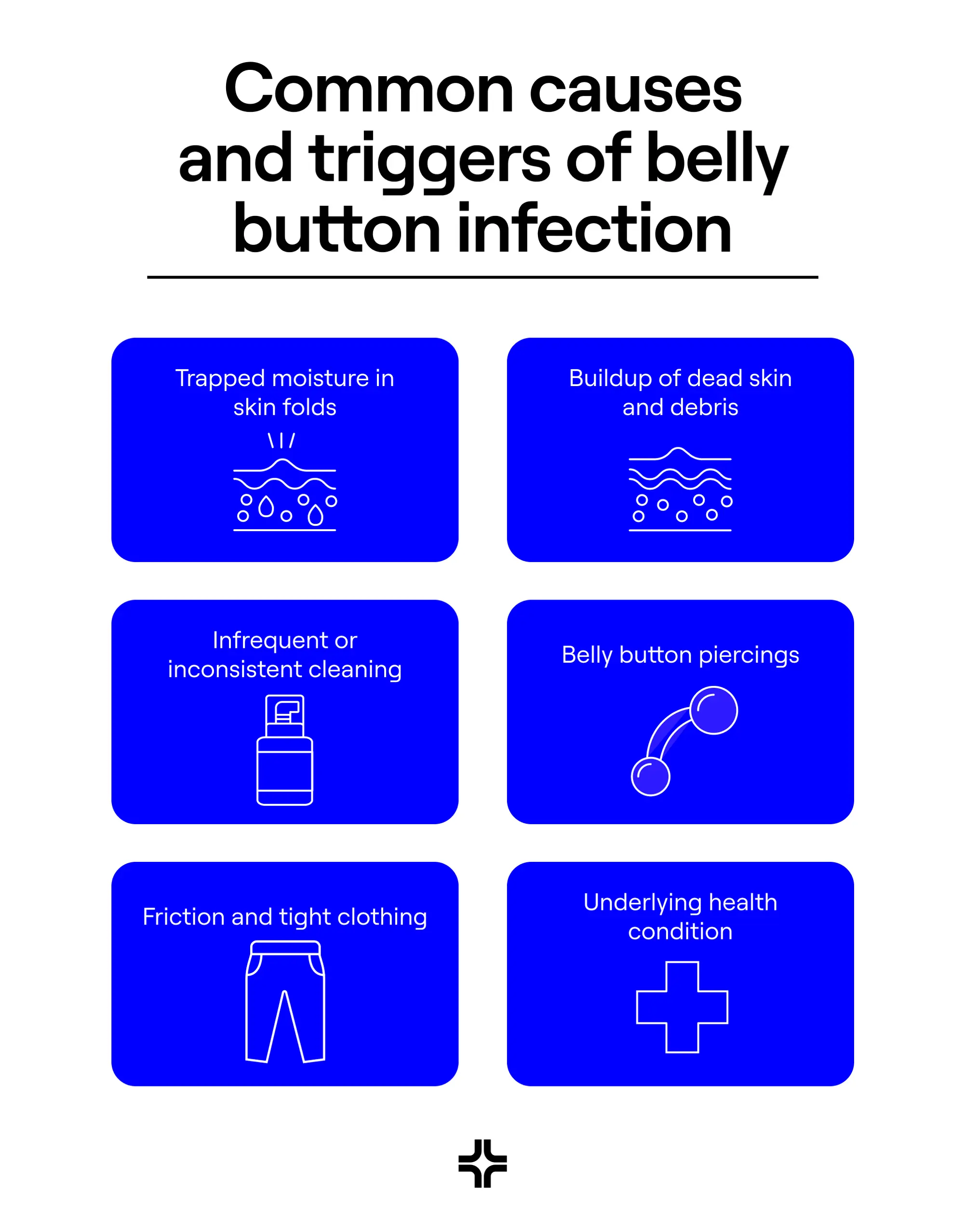
Common causes and triggers of belly button infection
- Trapped moisture in skin folds: Belly buttons (especially deep “innie” belly buttons) can collect sweat, water from showers, and moisture from workouts. When that moisture doesn’t fully dry, it creates a breeding ground for germs, says Krishnan.
- Buildup of dead skin and debris: Lint, dead skin cells, and oils can quietly accumulate in the navel over time, especially if it’s not cleaned regularly. This buildup feeds bacteria and yeast and can lead to infection, says Krishnan.
- Infrequent or inconsistent cleaning: Belly buttons often get skipped in daily hygiene routines. Without gentle, regular cleaning, irritation can progress into an early stage belly button infection.
- Belly button piercings: New piercings, trauma to an old piercing, or poor aftercare can all lead to an infected belly button. Touching the jewelry with unwashed hands, twisting it, or exposing it to pools and hot tubs too soon can raise the risk.
- Friction and tight clothing: Tight waistbands, belts, or athletic wear can rub against the navel, irritate the skin, and trap sweat, setting the stage for infection.
- Underlying health conditions: Conditions like diabetes, obesity, or HIV can make infections more likely or harder to heal. High blood sugar, in particular, can impair the body’s ability to fight off bacteria and yeast.
Signs and symptoms: what an early stage belly button infection looks like
An early stage belly button infection often starts subtly. At first, it may feel more annoying than alarming, which is why it’s easy to brush off. Paying attention to these early clues can help you step in before symptoms escalate:
- Mild redness, swelling, or irritation
- Itching or tenderness
- Clear or slightly cloudy fluid or light crusting inside the navel
- A mild odor that wasn’t there before
- Skin that feels a little warm
Early-stage infections stay limited to the skin. But when you start feeling symptoms that affect your whole body, it’s a clue the infection may be spreading and needs medical attention.
You may notice thicker discharge, a stronger smell, increasing pain, or swelling around the belly button. Fever, chills, fatigue, or generally feeling unwell can also signal that the infection is no longer confined to the skin and needs medical evaluation (more on that in a moment).
Will a belly button infection go away on its own?
Sometimes, but it depends on what you’re dealing with and how quickly you act.
Very mild irritation or the very earliest signs of a belly button infection can improve with basic care, including gentle cleansing, thorough drying, and avoiding anything that’s irritating the area, says Krishnan. If redness, itching, or mild odor start to settle within a day or two, that’s a good sign your body is handling it.
Once there are clearer signs of infection, though, it’s less likely to fully resolve on its own and it’s time to seek medical care, she adds. Increasing pain, spreading redness, pus, or worsening odor usually mean bacteria or yeast have gained a foothold that simple hygiene can’t undo by itself.
Waiting too long can also raise the risk of complications, especially for people with diabetes, weakened immune systems, or poor circulation, who may have a harder time fighting infection. In these cases, what starts as a small issue can linger or worsen without proper treatment.
Diagnosis and treatment options: how clinicians evaluate a belly button infection
If a belly button infection isn’t improving, a clinician can help take the guesswork out of what’s going on and point you toward the right treatment.
Clinical evaluation
An evaluation usually starts with a few straightforward questions. Your clinician will ask how long this has been happening, whether there’s pain, odor, or discharge, and if anything seems to make it better or worse. They’ll likely check in about recent belly button piercings, new soaps or body products, recent surgeries, or health conditions like diabetes that can affect how infections heal.
Next comes a quick, focused look at the area itself. This helps your clinician tell the difference between simple irritation and a true infection by checking for redness, warmth, swelling, or drainage. If there’s discharge, details like its color, thickness, and smell can offer useful clues about whether bacteria, yeast, or both are involved.
Swab or testing
Sometimes, a little extra information helps. A swab of the discharge may be taken to identify the exact germ causing the infection. Blood tests are uncommon, but they may be considered if there are signs that the infection could be affecting more than just the skin, such as fever or chills.
Getting an accurate diagnosis matters. Antibiotics won’t help a yeast infection, and antifungals won’t fix a bacterial one. With the right evaluation, your clinician can recommend targeted treatment that clears symptoms faster and lowers the chance of the infection making an unwanted return.
Non-surgical treatment options for belly button infections
In most cases, treating your belly button infection is straightforward and focused on calming the skin, clearing the infection, and keeping the area dry enough to heal. Here’s what that looks like in practice:
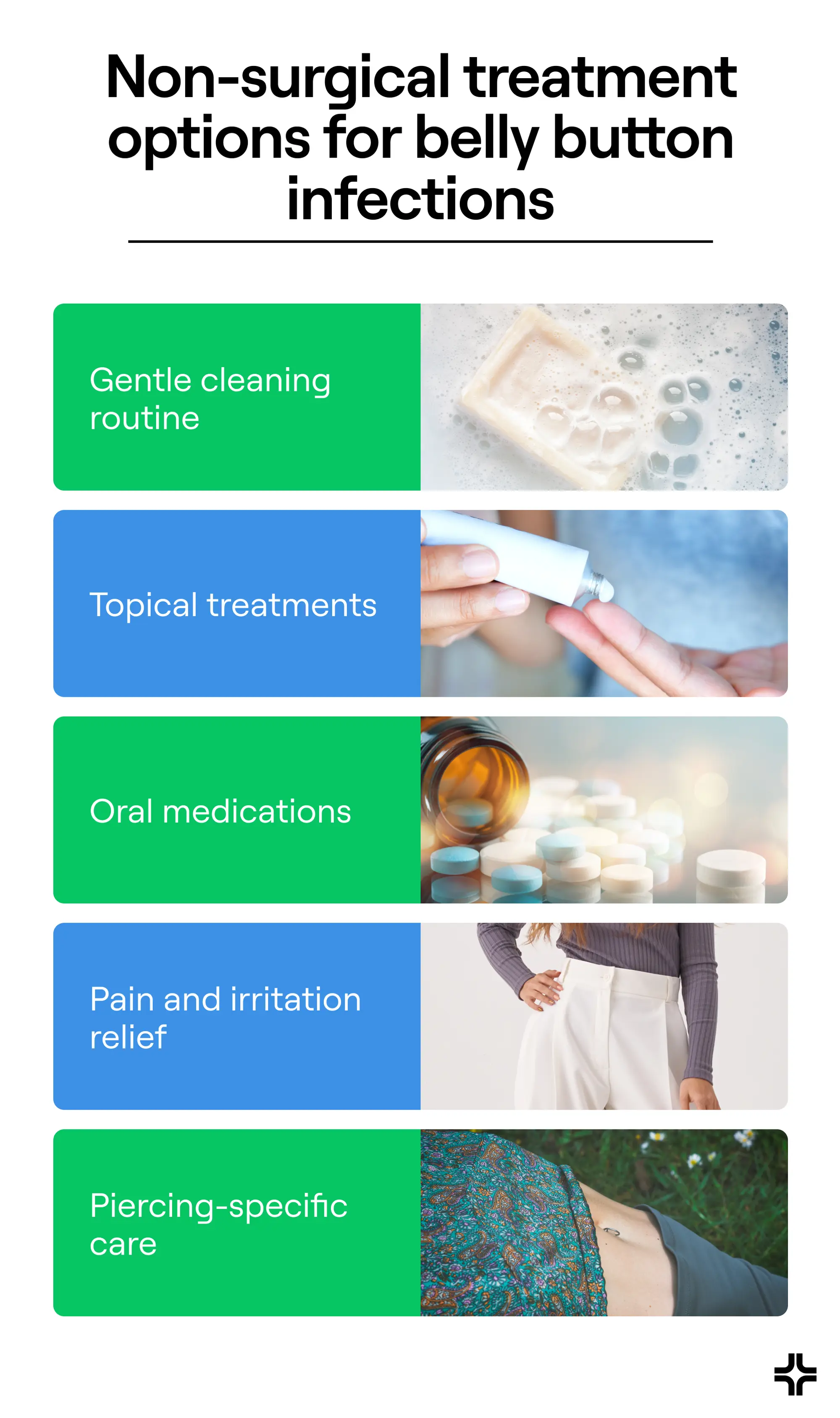
Non-surgical treatment options for belly button infections
- Gentle cleaning routines: Cleaning the area once or twice a day with warm water and a mild, fragrance-free soap is often enough. Avoid harsh scrubs, hydrogen peroxide, or alcohol, which can irritate the skin and slow healing. After washing, pat the area completely dry, says Krishnan—moisture control matters just as much as cleaning.
- Topical treatments: Depending on the cause, a clinician may recommend an over-the-counter or prescription antibiotic or antifungal cream, according to Krishnan. These are applied directly to the affected area and are often the first line of treatment for mild to moderate infections.
- Oral medications: If the infection is more extensive, painful, or not improving with topical care alone, oral antibiotics or antifungals may be prescribed, she adds. These help treat infections that are spreading or harder to reach with creams alone.
- Pain and irritation relief: Wearing loose, breathable clothing and avoiding tight waistbands can also reduce friction and pressure on the area while it heals.
- Piercing-specific care: If you have a belly button piercing, proper care is key. Gentle saline cleaning is usually recommended, and it’s important not to twist or remove jewelry unless a clinician specifically advises it. Removing jewelry too early can trap infection inside rather than help it drain.
Surgical and procedural options (when infections get complicated)
Rest assured that most belly button infections never make it anywhere near an operating room: Surgery is the exception, not the expectation. But in these rare cases, a procedure may be necessary:
- Abscess: An abscess is a pocket of infection that can’t drain on its own. When pus is trapped under the skin, a clinician may need to perform a small in-office procedure to drain it and relieve any pain or pressure.
- Foreign material trapped in the belly button: Compacted debris, hair, or buildup around an infected piercing can irritate the skin and keep an infection from healing. Removing the source of irritation is sometimes the key step that allows the area to finally recover.
- Underlying cyst or sinus tract: Less commonly, infection is linked to a cyst or sinus tract beneath the skin. According to Krishnan, these can cause repeated drainage and inflammation, making surface treatments ineffective. In these cases, you may need to have the cyst surgically removed to prevent the infection from coming back.
Needing a procedure doesn’t mean you’ve “failed” at home care. It usually means the infection is being stubborn. These are typically minor, case-by-case interventions, and a clinician can help figure out whether one of these procedures is the best next step for you.
When a belly button infection becomes dangerous: red flags and complications
“If an infection is left untreated for an extended period of time, there is a risk of adjacent skin or internal structures also becoming infected,” says Krishnan. Red flags that suggest the infection is no longer limited to the skin include:
- Rapidly spreading redness
- Severe or worsening pain
- Skin that looks dark, blistered, or unusually discolored
- Thick pus with a strong or foul odor that keeps returning or increases
- Swelling that feels firm or tense, which can signal an abscess
- Fever, chills, rapid heartbeat, dizziness, or feeling very unwell
These symptoms can signal complications like cellulitis, a deeper skin infection that spreads into surrounding tissue. In very rare cases, bacteria can move beyond the skin and get into the bloodstream, which can lead to more serious infections. This is when a belly button infection shifts from “uncomfortable” to “needs urgent medical care,” which is why worsening symptoms shouldn’t be brushed off or managed at home.
Working with a healthcare provider (virtual and in-person care)
If you’re staring at your belly button thinking, “Is this normal?”, that’s a perfectly good reason to check in with a healthcare provider. Belly button infections aren’t a one-size-fits-all situation, so they can help you figure out the cause of your symptoms (and how to treat them).
Virtual care with General Medicine can be an easy, low-stress first step for many people. During a virtual visit, you’ll talk through your symptoms, when they started, and what you’ve already tried. You may also be asked to share photos of the area (sure, it’s not glamorous, but it’s helpful!). From there, your provider will recommend next steps, prescribe medication when appropriate, or let you know if in-person care would be better.
In-person care is more likely if symptoms are severe, worsening quickly, or paired with fever or significant pain. And if you have diabetes, immune system conditions, or recent abdominal surgery, it’s smart to reach out sooner rather than later—infections can play by different rules when you have underlying health issues.
Whatever route you take, follow-through matters. Use your medications as prescribed, keep up with care even if things start improving, and check back in if symptoms don’t fully resolve. A little follow-up now can help prevent a repeat performance later.
Prevention and everyday care for a healthy belly button
Your belly button may be low-maintenance, but it’s not no-maintenance. A few simple habits can go a long way toward preventing irritation and keeping infections from making repeat appearances:
- Clean it gently: When you shower, give your belly button a quick, gentle clean with warm water and mild soap.
- Dry it like you mean it: Moisture is a major troublemaker here. After bathing or sweating, pat the area dry with a towel.
- Let it breathe: Tight waistbands and synthetic fabrics trap sweat. When you can, opt for breathable materials and avoid clothing that rubs or presses on your navel all day.
- Be smart about sweat: If you work out, live in a hot climate, or sweat easily, rinse and dry the area afterward.
- Follow piercing aftercare to the letter: New belly button piercings need patience. Stick to saline cleaning, avoid twisting the jewelry, and skip pools, lakes, and hot tubs until it’s fully healed.
- Manage underlying health conditions: Keeping health issues well-controlled and monitoring skin changes closely can lower your risk of infection.
Key takeaways
- Most belly button infections are mild and treatable, especially when caught early and managed with simple hygiene and moisture control.
- Early-stage symptoms (like redness, itching, mild discharge, or odor) stay on the skin and often improve within a couple of days with gentle care.
- Worsening pain, spreading redness, pus, or whole-body symptoms (like fever or chills) are signs the infection needs medical evaluation.
- Yeast and bacteria require different treatments, which is why getting the right diagnosis matters if your symptoms don’t improve.
- Serious complications are rare, but they’re more likely when infections are ignored or occur in people with higher health risks, such as diabetes or immune conditions.
- A virtual or telehealth session can be an easy first step to get guidance, prescriptions when appropriate, and peace of mind without waiting it out.
Frequently asked questions (FAQs)
When is a belly button infection serious?
A belly button infection becomes serious when symptoms go beyond mild skin irritation. Red flags include spreading redness, increasing pain, thick or foul-smelling discharge, fever, chills, or feeling unwell overall. These signs suggest the infection may be spreading and should be evaluated by a clinician.
Should I go to the ER for a belly button infection?
Most belly button infections do not require an ER visit. However, you should seek urgent or emergency care if you have severe pain, rapidly spreading redness, high fever, dizziness, or signs of systemic illness. If you’re unsure, a virtual visit can help determine whether in-person or emergency care is needed.
What does a severe belly button infection look like?
A severe infection may involve intense pain, significant swelling, dark or blistered skin, pus that keeps returning, or redness spreading beyond the belly button. Systemic symptoms—such as fever, chills, or fatigue—are also warning signs that the infection is no longer confined to the skin.
Can a belly button infection heal itself?
Very mild irritation or an early-stage belly button infection may improve with proper cleaning, drying, and avoiding irritation. Once there’s worsening pain, pus, spreading redness, or no improvement after a couple of days, it’s unlikely to fully heal on its own and should be evaluated by a clinician.
How long does it take for a belly button infection to heal?
With appropriate care, many mild infections start improving within a few days. More stubborn infections—or those requiring prescription treatment—may take longer, especially if there’s an underlying condition or repeated irritation. If symptoms aren’t improving within about 48 hours, it’s a good idea to check in with a healthcare provider.
Our editorial standards
At General Medicine, we cut through the clutter to make health care clearer, faster, and easier to navigate. Every article is grounded in evidence-based research and peer-reviewed journals, reviewed by medical professionals, and written in accessible language that helps you make health decisions with confidence. We’re committed to ensuring the quality and trustworthiness of our content and editorial process by providing information that is up-to-date, accurate, and actually useful. For more details on our editorial process, see here.