Mar. 3, 2026
Anxiety Chest Pain: Why It Happens and How to Find Relief

Lane Thaut, DO
Jump to
Book a visit
$25 typical copay
$100 without insurance
Get evaluated for anxiety and chest pain to see if they are related.
Anxiety can be a real jerk sometimes, even leading to a stabbing feeling in your chest. But so can several other conditions, which can present a conundrum for anyone experiencing chest pain. Is it a heart issue, a lung issue, a mental health issue, or that-pizza-slice-you-had-for-lunch-not agreeing-with-you issue? And what should you do? Thankfully, you can use some clues to determine if anxiety is doing you dirty.
Imagine this scenario: You have an interview for your dream job in 15 minutes. But while sitting in the parking lot preparing yourself with the three best adjectives to describe yourself or coming up with the answer to that annoying question about your worst quality or weakness, you suddenly feel a stabbing sensation between your ribs. A quick check reveals that the serial killer from the thriller you’ve been reading has not slipped into your car. So what’s up?
Your breathing and heart rate intensify, and beads of sweat roll down your neck and spine, making you want to tear off your blazer. You clutch your car door against a wave of wooziness, and you wonder: Is it anxiety or a heart attack?
That might sound like a dramatic question, but when anxiety strikes, the sensations can be intense. Emotions—such as fear, stress, worry, and more—originate in your brain’s limbic system, but they don’t just affect you mentally. They also manifest physically, sometimes causing pain.
Chest pain is always something to take notice of rather than brushing it off as nothing. Your discomfort may be related to anxiety, especially if you’re facing a stressful situation. Of course, anxiety can occur without an obvious trigger. (Hello, existential dread.)
So how do you know whether your chest pain is from anxiety or if you’re experiencing myocardial infarction (MI), a heart attack? Some clues can help you solve the puzzle. Of course, whenever you’re in doubt about the cause of chest pain, seeking medical attention is warranted.
In this article, we cover whether anxiety can cause chest pain (spoiler alert: yes!), how to relieve chest tightness from anxiety, and more.
Anxiety chest pain: How it feels
The medical term for chest pain from anxiety is noncardiac chest pain (NCCP), and it’s a real phenomenon accounting for about half of emergency department visits for chest discomfort. Chest pain is a common occurrence for people with panic disorder (PD) and generalized anxiety disorder (GAD).
“Many people during a panic attack go to the emergency room worried they are having a heart attack, highlighting the overwhelming discomfort of anxiety,” says Taylor Barragan, a psychiatric mental health nurse practitioner and founder of Praxis Mental Health.
Anxiety chest pain typically feels like a sharp or stabbing sensation, often between the ribs, and it may occur only when you inhale.
Symptoms that may accompany anxiety chest pain:
- Shortness of breath
- Fast or shallow breathing
- Heart palpitations (racing heart)
- Sweating or feeling hot
- Gastrointestinal (GI) discomfort, such as nausea or diarrhea
- Dizziness
- Difficulty focusing
- Tingling in your hands, arms, or face
- Shaking or trembling
Can anxiety cause chest pain? The stress-body connection
“Chest pain is often a symptom of anxiety because the stress response linked to anxiety causes physiological changes,” Barragan says.
Yep, we’re talking about that good ol’ “fight-or-flight” stress response. Your autonomic nervous system (ANS) controls your body’s involuntary processes, such as breath rate, heart rate, body temperature, digestion, and even sexual arousal.
The ANS includes two main branches:
- Sympathetic nervous system: This is your stress response, often called “fight or flight.”
- Parasympathetic nervous system: This is your calm response, often called “rest and digest.”
Your body is designed to flee from predators (lions and tigers and bears, oh my). And indeed our ancient ancestors had to do just that. In modern times, we sometimes face major threats (such as surviving a wildfire), but even everyday stressful situations, such as having to give a presentation or performance, or anxiety that occurs without an obvious trigger, can place you in fight-or-flight mode.
Fight or flight loads your bloodstream up with stress hormones so that you can respond to a potential threat. Your stress response starts in your brain. Your noggin then sends an alert to your adrenal glands to secrete glucocorticoids, or steroid hormones, as well as epinephrine, also known as adrenaline.
If you experience ongoing stress, your brain keeps the red flag waving, leading to a hormonal domino effect. The hypothalamus, a part of the brain, releases corticotropin-releasing hormone. This signals the pituitary gland to release adrenocorticotropin hormone. And this tells the adrenal gland to release cortisol, commonly called “the stress hormone.”
These processes cause your body to mostly turn off your rest and digest mode so that all your bodily resources go toward responding to the threat at hand. This is why stress or anxiety can sometimes cause GI upset, whether nausea, diarrhea, or reflux.
In fight-or-flight mode, your heart rate, breath rate, blood pressure, and body temperature go up, and you may even hyperventilate, taking rapid breaths, which causes “air hunger.” Yes, you can actually be hungry for more air.
These factors can cause your intercostal muscles (layers of muscles between your ribs) to spasm or tighten and your heart to pound, leading to chest discomfort and that feeling that something is horribly wrong. This, understandably, can also cause even more anxiety as you wonder what to do, all while not being able to think straight. Gah!
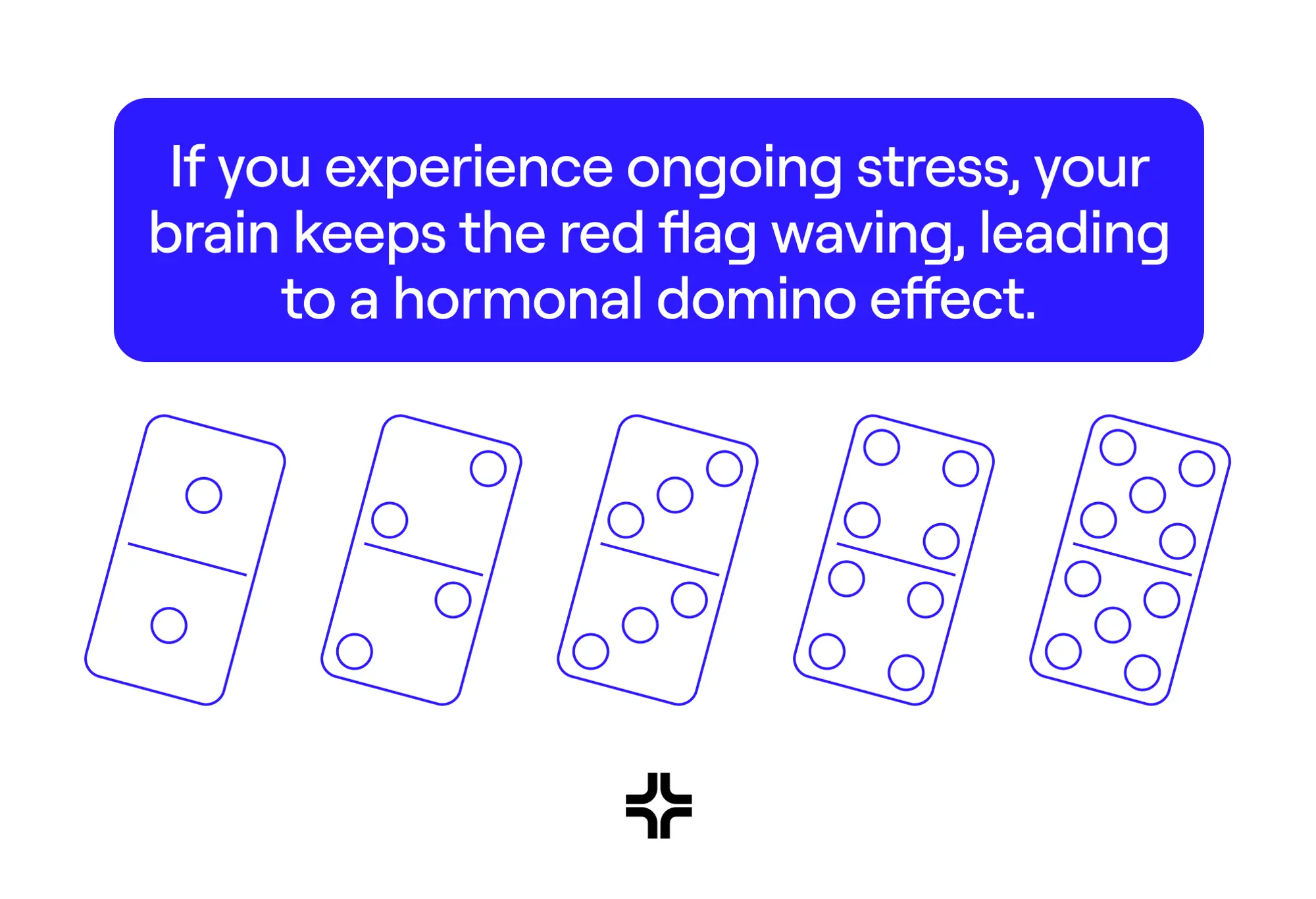
Illustration of the "hormonal domino effect" from ongoing stress
“All these changes can cause genuine chest discomfort,” Barragan says. “People with anxiety may also have lower pain thresholds, experience hypervigilance of bodily sensations, and experience dysregulation in their autonomic nervous system.”
The potentially lower pain threshold is not because you are somehow weak, however. Researchers are still trying to figure out the links here, but likely anxiety heightens nociceptive awareness, your body’s ability to detect harmful stimuli. And hypervigilance means you’re subconsciously overly focused on potential threats, keeping your fight-or-flight mode activated. It’s an issue that can occur from past trauma.
Anxiety attack vs panic attack vs heart attack: Key differences
How do you know whether you’re having an anxiety attack, panic attack, or heart attack? Should you just throw a dart at a wall and see where it sticks? No, we’ll break it down for you. First, let’s explore the difference between an anxiety attack and a panic attack.
- Panic attacks come on suddenly, often with severe symptoms and without warning, and then resolve.
- Anxiety attacks tend to build slowly before reaching a peak, and their symptoms are generally less intense than those of panic attacks.
Now for a comparison between anxiety/panic and a heart attack: “Chest pain caused by the heart is often a heavy, squeezing sensation that comes on with exertion and may spread to the arm, jaw, or back,” Barragan says. “With anxiety, pain patterns tend to be more sharp than pressure-like, may ebb and flow, may be worse when taking a deep breath, may change when you change positions, and may be localized to one small spot.”
Again, if you’re in distress, never hesitate to seek immediate medical attention for chest pain. However, some context clues can also help you make an informed decision. For example, maybe the sensation is familiar to you from when you previously experienced anxiety and chest pain at the same time. Additionally, if the chest pain resolves as your anxiety calms, that can also be a clue that the two are linked.
Other causes: Can stress cause chest pain that isn’t anxiety or a heart attack?
Chest pain isn’t just caused by anxiety or a heart attack. It’s a symptom of several other conditions and situations that are worth considering.
- Musculoskeletal chest pain: If you’ve ever hit the weights too hard at the gym or got overzealous in a workout class, you might notice discomfort in the days after, which is called delayed onset muscle soreness (DOMS). This can affect the chest muscles.
- Costochondritis: Inflammation of the cartilage that connects your ribs to your sternum (breastbone) can cause a stabbing or aching sensation in the chest.
- Lung conditions: Chronic lung conditions, including asthma, chronic obstructive pulmonary disease (COPD), and more can also cause chest tightness or pain. Likewise, acute respiratory infections, including bronchitis, pneumonia, and the like can lead to discomfort, including from ongoing coughing.
- Pulmonary embolism (PE): Sometimes a blood clot travels to the lungs and blocks an artery. Symptoms typically come on suddenly and do not resolve without treatment. This is a medical emergency.
- Heartburn or reflux: Gastroesophageal reflux disease (GERD) or occasional heartburn can also lead to chest discomfort.
- Heart conditions: Several other heart conditions aside from a heart attack can drive chest pain, including angina (reduced blood flow to the heart), pericarditis (inflammation of the sac around the heart), myocarditis (inflammation of the heart), coronary artery disease (CAD), aortic dissection (a tear in the aorta), heart valve issues, and stress cardiomyopathy (aka “broken heart syndrome,” which is a temporary weakening of the heart muscle resulting from stress).
Diagnosis and treatment options: how clinicians evaluate chest pain
“The American College of Cardiology and the American Heart Association guidelines emphasize that life-threatening cardiac conditions must be ruled out in order to attribute these symptoms to anxiety,” Barragan says. “So if you are experiencing pressure, tightness, squeezing, heaviness or burning in the chest, you should be evaluated in the emergency room where they will use a test called an electrocardiogram to rule out serious conditions.”
Working with a healthcare provider: Building a plan for anxiety and chest pain
If you’ve ruled out an immediate life-threatening heart issue, you might wish to work with a healthcare provider who can help you determine the source of your chest pain or manage your anxiety symptoms, which can then also help alleviate any associated chest pain. Need advice? You can make a telehealth appointment with General Medicine.
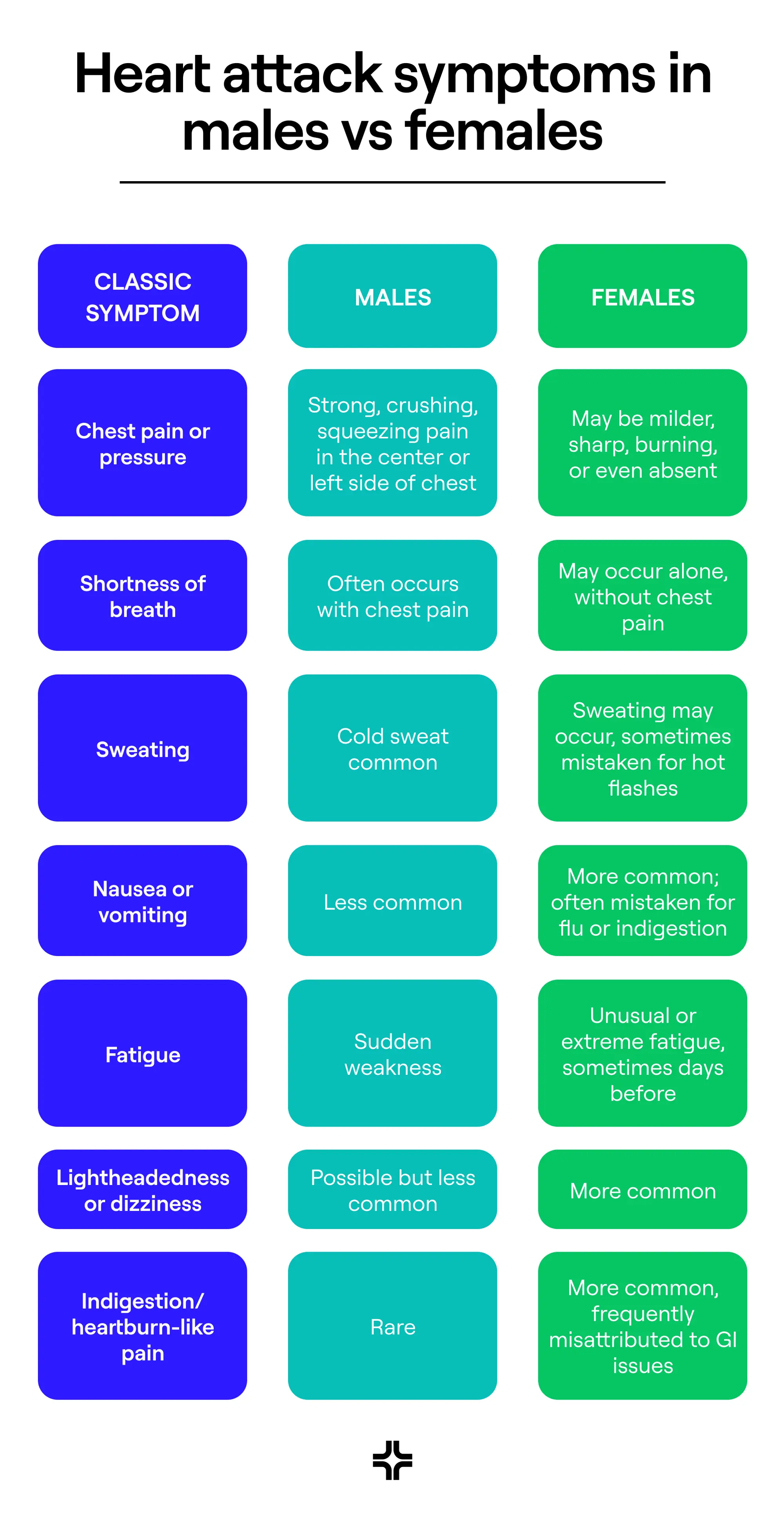
Heart attack symptoms in males vs females
Seek emergency care if:
- Your chest pain comes on suddenly and is severe
- You’re experiencing a crushing pressure
- Your pain radiates to your back, arms, shoulders, neck, or jaw
- You experience nausea or vomiting along with your chest pain
- You break into a cold sweat or sweat in general with your chest pain
- You have intense fatigue with your chest pain
- You experience sudden weakness with your chest pain
- Your chest pain does not resolve within a few minutes or worsens
Keep in mind that people assigned female at birth can have somewhat different heart attack symptoms than those assigned male.
Classic symptoms
How to relieve anxiety chest pain
If you know you’re experiencing a panic attack or anxiety, you can try a calming technique. Box breathing helps you shift your focus to your breath, easing you out of fight-or-flight mode and back to rest-and-digest mode.
Box breathing:
- Inhale for a count of four.
- Hold for a count of four.
- Exhale for a count of four.
- Hold for a count of four.
- Repeat until you feel calmer.
Key takeaways
- Anxiety can be intense for your body and even show up as chest pain.
- If your chest pain is sudden and intense, or you have additional unexplained symptoms, seek emergency medical attention.
- If you tend to experience anxiety chest pain, General Medicine can help you manage your symptoms or they can investigate why chest pain is showing up for you.
FAQ
What do anxiety chest pains feel like?
Chest pain from anxiety is typically sharp or a stabbing sensation, often felt between the ribs because of your intercostal muscles spasming or tightening.
Can stress cause chest pain or pressure?
When stress ratchets up, you might feel pain in your chest. But the pain is generally more of a sharp sensation rather than one of tightening or pressure. If you feel your chest constricting, seek medical attention right away.
What is the 3-3-3 rule for anxiety?
The 3-3-3 rule is a technique you can use to bring yourself back to a state of calm when anxiety strikes or builds. Name three things you see, followed by three things you hear. Next, move three body parts. The process helps distract you from anxious thought patterns and refocuses your attention on the present.
Our editorial standards
At General Medicine, we cut through the clutter to make health care clearer, faster, and easier to navigate. Every article is grounded in evidence-based research and peer-reviewed journals, reviewed by medical professionals, and written in accessible language that helps you make health decisions with confidence. We’re committed to ensuring the quality and trustworthiness of our content and editorial process by providing information that is up-to-date, accurate, and actually useful. For more details on our editorial process, see here.
Related Articles