May. 11, 2026
Understanding the Mind–Body Connection

Dr. Polina Teslyar, Dr. Corey Siegel, Dr. Adam Cohen, and Dr. Cody Foster

Understanding the Mind–Body Connection
Jump to
Book a visit
Book a visit
$25 typical copay
$100 without insurance
IBS is a disorder of the gut–brain interaction causing abdominal pain, bloating, and altered bowel habits. It's strongly influenced by stress and emotions. Struggling with IBS? Talk to a General Medicine clinician today.
Why your brain and body speak the same language — and what you can do when the signals get crossed.
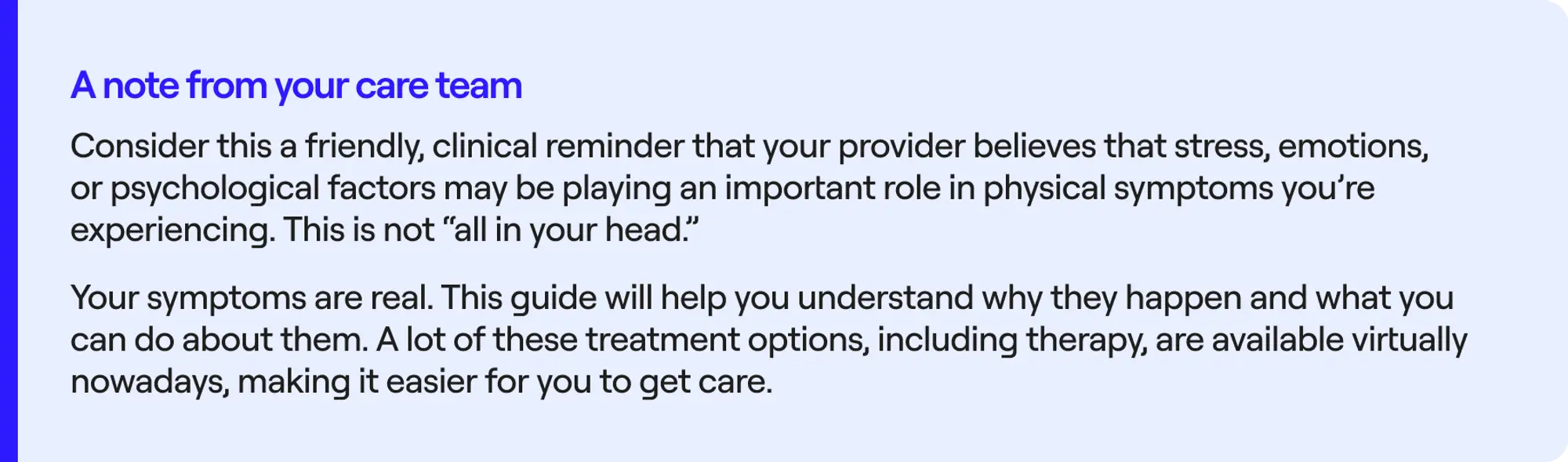
Consider this a friendly, clinical reminder that your provider believes that stress, emotions, or psychological factors may be playing an important role in physical symptoms you're experiencing. This is not "all in your head".Your symptoms are real. This guide will help you understand why they happen and what you can do about them. A lot of these treatment options, including therapy, are available virtually nowadays, making it easier for you to get care.
Your Symptoms Are Real
You may be experiencing symptoms like pain, tingling, numbness, tremors, dizziness, fatigue, weakness, and even thinking, speaking, or walking changes, which are distressing and disruptive to your daily life. You may have had tests — blood work, imaging, nerve studies — that came back normal. This can feel frustrating, even frightening.
Here’s what’s important to know: a normal test result does not mean nothing is wrong. It means the cause of your symptoms are not a structural problem like a tumor, a pinched nerve, or organ damage. Instead, your symptoms may be a problem caused by how your nervous system is processing and amplifying signals — a real, well-studied medical phenomenon.

Key takeaway Your symptoms are not imaginary. They are produced by your nervous system, and they can be understood, managed, and often significantly improved.
How the Mind–Body Connection Works
Your brain and body are in constant two-way communication. The brain doesn’t just receive signals from the body — it actively interprets, filters, and sometimes amplifies them. When you’re under stress, anxious, or emotionally overwhelmed, this communication system can become dysregulated. Many people suffer such brain-body communication breakdowns because of these various forms of emotional stress, while many others have similar brain-body communication breakdowns without clear stressors identified. Yet, for both types of people, it’s often useful to understand all forms of stress to explore all avenues that will improve symptoms.
The Stress Response
When your brain perceives a threat — whether it’s physical danger or emotional stress — it activates your “fight or flight” system. This triggers real, measurable physical changes:
- Muscle tension and pain — stress hormones cause muscles to tighten, often in the neck, shoulders, back, or jaw, leading to chronic pain and headaches.
- Nerve sensitization — your nervous system can become “turned up,” making normal sensations feel painful (tingling, burning, numbness) even without nerve damage.
- Racing heart beat--your heart may beat faster, you may feel chest tightness or pain
- Difficulty breathing--it may feel like you cannot take a full breath, you may hyperventilate
- Skin changes--you may have rashes or hives
- Digestive disruption — the gut has over 100 million nerve cells. Stress directly affects digestion, causing nausea, bloating, cramping, or changes in bowel habits.
- Fatigue and brain fog — a nervous system stuck in “high alert” burns enormous energy, leaving you exhausted even after rest.
- Tremors and weakness — functional tremors and limb weakness can occur when the brain’s motor signaling is disrupted by stress, not by neurological disease.
- Sleep disruption — you may have trouble falling asleep, staying asleep, or waking feeling rested. Poor sleep can significantly worsen pain, fatigue, mood changes, brain fog, and other symptoms described above, creating a cycle that reinforces them.
The Vicious Cycle
One of the most important things to understand is the feedback loop between symptoms, stress of all flavors, and more symptoms:
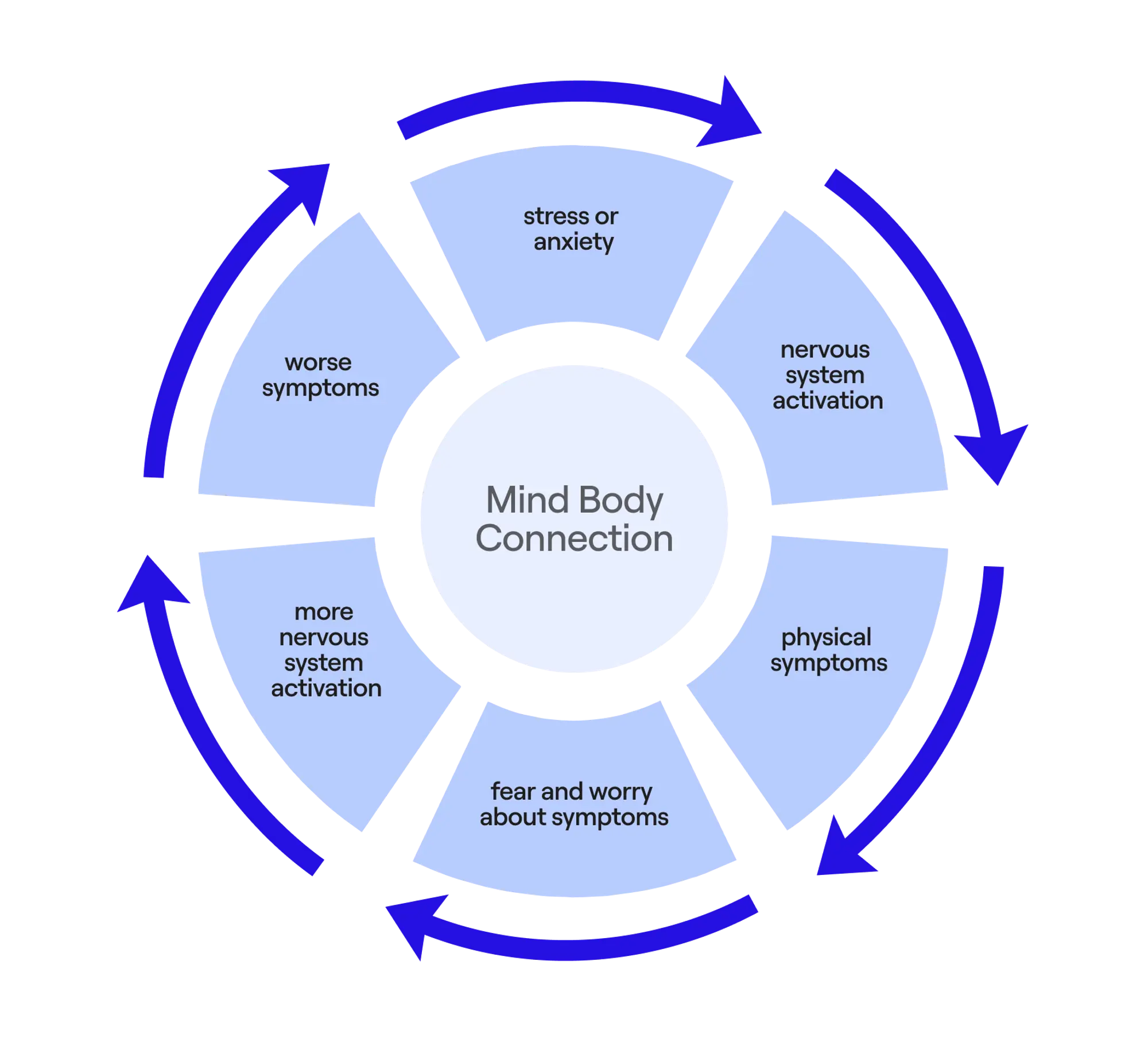
Stress or anxiety → nervous system activation → physical symptoms → fear and worry about symptoms → more nervous system activation → worse symptoms
Breaking this cycle is the primary goal of treatment. When you understand what’s happening, the fear begins to lose its power, and the symptoms often begin to improve.
Conditions You May Have Heard Of
Your provider may use one or more of these terms. They all describe different aspects of the mind–body connection:
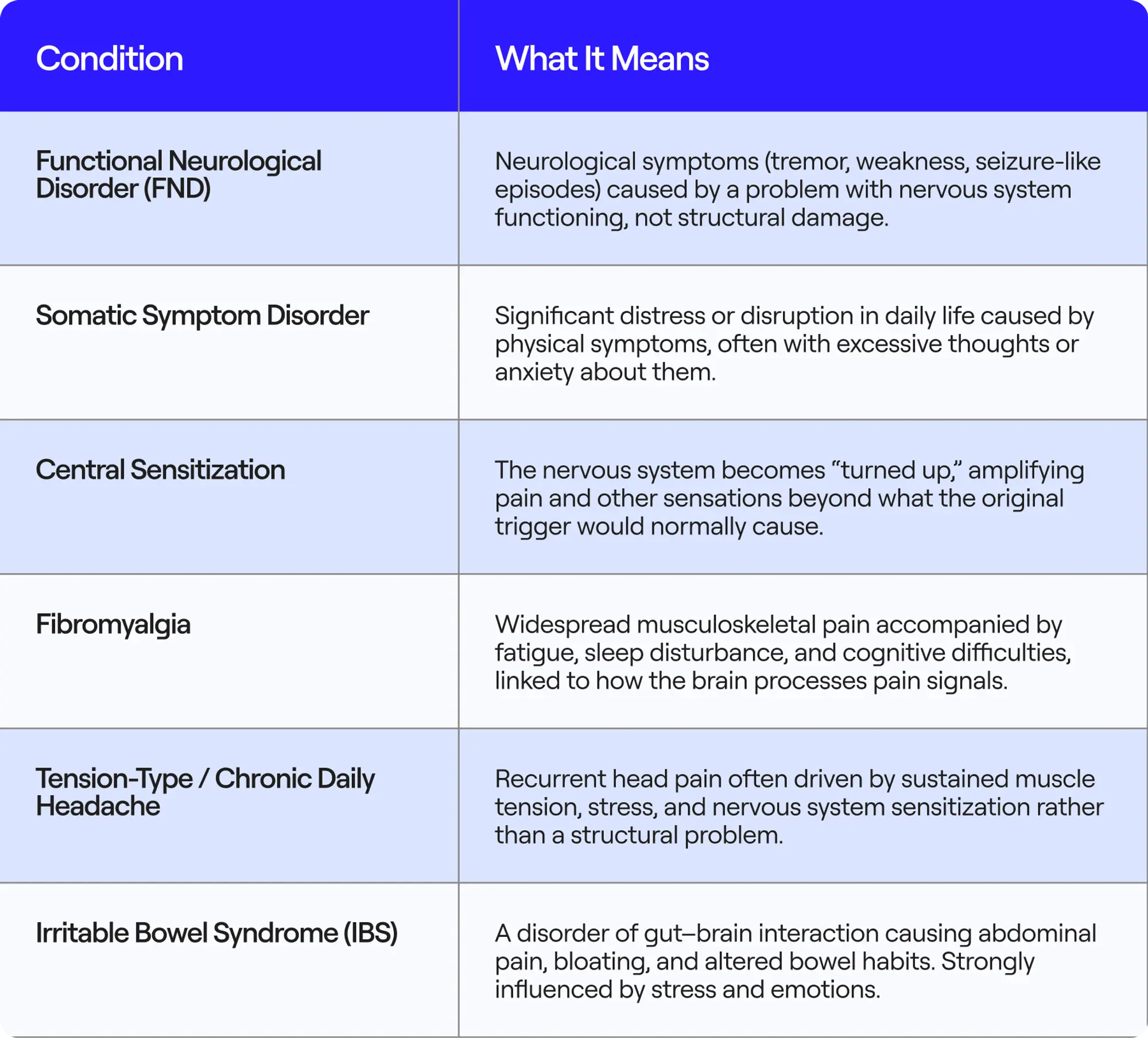
This includes conditions such as: Functional Neurological Disorder, Somatic Symptom Disorder, Central Sensitization, Fibromyalgia, Tension-Type Headache, and IBS
Important: These are all legitimate medical diagnoses with active research communities, established treatment approaches, and good evidence for improvement. They are not labels for “unexplained” problems — they reflect our growing understanding of how the nervous system works.
What You Can Do
Recovery from mind–body symptoms is possible and well-documented, but it takes some commitment and work on your part. The following approaches have the strongest evidence:
1. Education and Understanding
Simply understanding the mind–body connection — the fact that your symptoms are real but driven by nervous system dysregulation rather than structural damage — is itself therapeutic. Being open to a new cause of symptoms – and a new treatment pathway – is often a big part of the battle for many people. Research shows that patients who understand this mechanism often begin to improve. You’re already taking this step by reading this guide.
2. Cognitive Behavioral Therapy (CBT)
CBT is the most studied psychological treatment for mind–body conditions. It helps you identify thought patterns that fuel the stress–symptom cycle and develop practical strategies to interrupt them. CBT has strong evidence for chronic pain, IBS, fibromyalgia, and functional neurological symptoms.
3. Mindfulness and Stress Reduction
Mindfulness-based stress reduction (MBSR) and similar practices help calm an overactive nervous system. Even brief daily practice (10–15 minutes) can reduce symptom severity over time. The goal is not to “think your way out” of symptoms but to reduce the background level of nervous system activation.
4. Graded Exercise and Movement
Gentle, gradually increasing physical activity is one of the most effective interventions for chronic pain, fatigue, and functional neurological symptoms. Movement helps “retrain” the nervous system, reduce fear of physical activity, and improve mood. Start small — even 5–10 minutes of walking — and build gradually.
5. Sleep Hygiene
Poor sleep dramatically worsens nervous system sensitization, making pain, fatigue, stress, anxiety, and brain fog more intense. Prioritizing consistent sleep habits — regular bedtime, limiting screens before bed, avoiding late caffeine or alcohol, creating a cool and dark sleep environment — can meaningfully reduce symptom burden. Even small improvements in sleep consistency can calm an overactive nervous system.
6. Addressing Anxiety and Depression
Anxiety is the single most common driver of mind–body symptoms. If your provider has discussed anxiety or depression with you, treating these conditions directly — through therapy, medication, or both — often leads to significant improvement in physical symptoms as well.
What Recovery Looks Like
Recovery from mind–body conditions is rarely a straight line. Here’s what you can realistically expect:
- Progress is gradual. Most people see meaningful improvement over weeks to months, not days.
- Flare-ups happen. Periods of stress may temporarily worsen symptoms. This does not mean you’re “going backward” — it’s a normal part of recovery.
- Understanding reduces fear. Once you know what’s happening, symptom flare-ups become less frightening, which itself helps break the cycle. This is the most crucial thing to know and internalize because it produces a longer-term recovery.
- Multiple approaches work together. Combining education, therapy, movement, and stress management is more effective than any single intervention.

You are not alone Mind–body conditions are among the most common reasons people see a doctor. Roughly 1 in 3 symptoms seen in primary care have no identifiable structural cause. Millions of people live with these conditions, and many achieve significant recovery.
Recommended Resources
Your care team recommends the following books, websites, and tools for further learning:
Books
- The Body Keeps the Score by Bessel van der Kolk, MD — A landmark book on how trauma and stress live in the body and how to heal. Highly recommended as a starting point.
- The Secret to Mental Health by George Pransky, PhD — An accessible audiobook/book on the three principles of psychology and innate mental wellbeing. Available on Amazon and Audible.
- Unlearn Your Pain by Howard Schubiner, MD — A practical workbook for chronic pain driven by the mind–body connection, with exercises and a structured 28-day program.
- The Way Out by Alan Gordon, LCSW — Written by the developer of Pain Reprocessing Therapy, with clear explanations and practical tools for retraining the brain’s pain response.
Film
- This Might Hurt (thismighthurtfilm.com) — A documentary following three chronic pain patients through a groundbreaking medical program run by Dr. Howard Schubiner that focuses on uncovering hidden causes of pain and retraining the brain to switch it off. Based on Pain Reprocessing Therapy, which was found effective in randomized trials and listed as a “best practice” by the HHS’s task force to combat the opioid epidemic. Available to stream.
Free Programs and Tools
- Alan Gordon’s Free 21-Day Pain Recovery Program (tmswiki.org) — A free, self-guided program created by the developer of Pain Reprocessing Therapy. A good starting point if you want to begin working on symptoms on your own.
- Dr. Schubiner’s Unlearn Your Pain Online Course — A low-cost online companion to the book, with structured exercises for retraining pain pathways.
- Symptom Assessment Quiz (thismighthurtfilm.com/quiz) — A quick self-assessment to help you understand whether mind–body approaches may apply to your symptoms.
- PPDA Practitioner Directory (ppdassociation.org) — The Psychophysiologic Disorders Association maintains a directory of doctors and therapists who specialize in mind–body approaches to pain and other symptoms.
Videos and Podcasts
- "Why Things Hurt" — Dr. Lorimer Moseley, TEDxAdelaide — An engaging, accessible talk by a leading pain neuroscientist explaining how pain works in the brain. A great introduction to the science.
- "Science Vs: Chronic Pain — Can Our Brains Fix It?" (Spotify/Gimlet) — An accessible podcast episode covering Pain Reprocessing Therapy, featuring researchers and a personal story of recovery from fibromyalgia.
- Dr. Schubiner’s Google Talk on Chronic Pain — A lecture-style presentation explaining how the brain generates and maintains chronic pain, and what can be done about it. Available on YouTube.
Websites and Online Resources
- Peace From Within (peace-from-within.com) — Anxiety coach Lily Sais offers content on YouTube, Instagram, and a podcast focused on anxiety, panic, and OCD through the lens of three principles psychology.
- 3 Principles Global Community (3pgc.org) — A global community exploring the three principles approach to mental health and wellbeing, with events and educational resources.
- Curable App (curablehealth.com) — An evidence-based app for chronic pain that includes guided meditations, brain-retraining exercises, and educational content.
- FND Hope (fndhope.org) — An international nonprofit providing information, support, and resources for people living with Functional Neurological Disorder.
- Neurosymptoms.org — Created by a leading FND researcher (Prof. Jon Stone), offering patient-friendly explanations of functional neurological symptoms with diagrams and videos.
- Dartmouth Hitchcock GI Behavioral Health (dartmouth-hitchcock.org/gi/gi-behavioral-health) — One of the nation's leading academic programs dedicated to the brain–gut connection. Their patient education page includes an animated video explaining how the brain and digestive system communicate, a diaphragmatic breathing tutorial you can try on your own, and information on evidence-based treatments like gut-directed hypnotherapy and GI-focused CBT. Especially helpful if your symptoms include abdominal pain, bloating, IBS, or other digestive issues.
Apps for Daily Practice
- Headspace or Calm — Guided mindfulness and meditation apps. Even 10 minutes daily can help reduce nervous system activation.
- Insight Timer — A free meditation app with thousands of guided sessions including specific tracks for chronic pain and anxiety.
When to Contact Your Provider
While mind–body symptoms are not dangerous, you should contact your care team if:
- You develop new or significantly different symptoms that feel unlike your usual pattern.
- You experience sudden severe headache, vision changes, difficulty speaking, or one-sided weakness (seek emergency care).
- Your symptoms are worsening despite consistent effort with the strategies above.
- You are experiencing worsening depression, hopelessness, or thoughts of self-harm.
- You would like a referral to a therapist, psychiatrist, or specialist.
Your care team is here to support you. Recovery is a collaborative process, and you don’t have to navigate it alone. Please reach out any time you have questions or need guidance.
Our editorial standards
At General Medicine, we cut through the clutter to make health care clearer, faster, and easier to navigate. Every article is grounded in evidence-based research and peer-reviewed journals, reviewed by medical professionals, and written in accessible language that helps you make health decisions with confidence. We’re committed to ensuring the quality and trustworthiness of our content and editorial process by providing information that is up-to-date, accurate, and actually useful. For more details on our editorial process, see here.